 RRB
RRB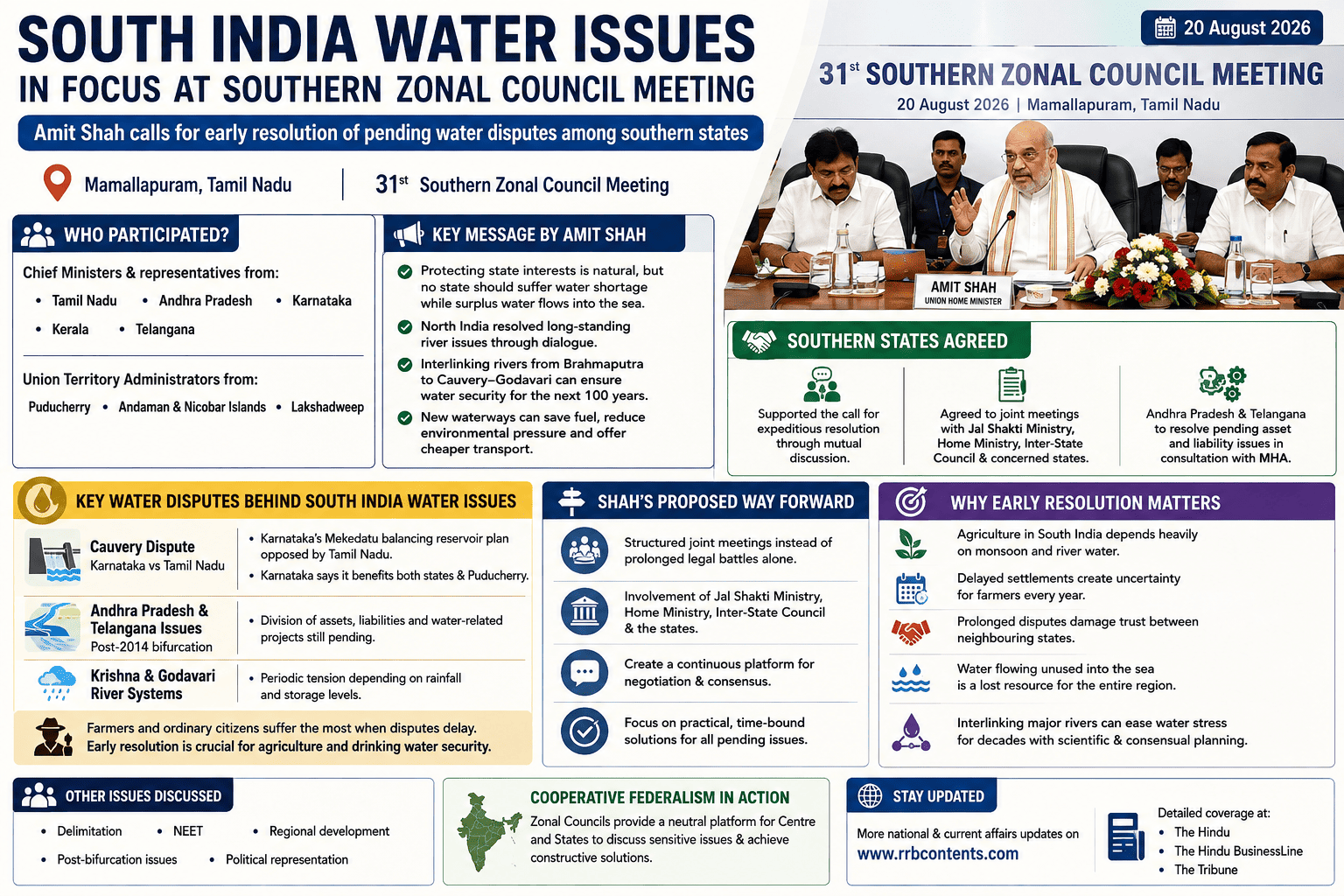
South India water issues returned to the centre of national attention on 20 August 2026. Union Home Minister Amit Shah chaired the 31st Southern Zonal Council meeting at Mamallapuram near Chennai. As a result, pending river disputes among southern states came up for serious discussion. Therefore, the meeting carried both political and practical importance.
Shah stressed the need for early resolution of these long-pending problems. In addition, he suggested joint meetings involving the Ministry of Jal Shakti, the Ministry of Home Affairs, the Inter-State Council and the concerned states. Consequently, the focus shifted from confrontation to structured dialogue.
The southern states largely agreed with the suggestion. They supported the idea of resolving disputes through mutual discussion and constructive solutions. Meanwhile, other regional concerns such as delimitation and post-bifurcation issues also figured in the talks.
South India Water Issues at the Southern Zonal Council Meeting
The meeting brought together chief ministers and representatives from Tamil Nadu, Andhra Pradesh, Karnataka, Kerala and Telangana. Union Territory administrators from Puducherry, Andaman and Nicobar Islands and Lakshadweep also attended. First, Amit Shah set the tone by highlighting the need for cooperation. Second, he pointed out that protecting one’s own state interest is natural. However, if that approach leaves other states without water for years while surplus water flows into the sea, no real public interest is served.
He referred to the experience of North India. There, several long-standing river-sharing issues from Kashmir to Uttar Pradesh have been resolved over time. Therefore, a similar spirit of dialogue could help the South as well. Moreover, Shah spoke about the larger idea of interlinking major rivers. He said connecting rivers from the Brahmaputra to the Cauvery and the Godavari could help India avoid water shortage for the next 100 years.
In addition, such interlinking could create new waterways. These waterways would save fuel, reduce environmental pressure and offer cheaper transport. As a result, the discussion moved beyond immediate disputes to long-term water security.
Key Water Disputes Behind South India Water Issues
South India water issues have remained sensitive for decades. The most prominent is the Cauvery dispute between Karnataka and Tamil Nadu. Karnataka’s proposed Mekedatu balancing reservoir has further complicated the matter. Tamil Nadu has consistently opposed the project, arguing that it could affect its rightful share. Meanwhile, Karnataka maintains that the project will also benefit farmers in Tamil Nadu and Puducherry.
Andhra Pradesh and Telangana continue to face issues linked to the 2014 bifurcation. Division of assets, liabilities and water-related projects still require settlement. In addition, other river systems such as Krishna and Godavari also generate periodic tension depending on rainfall and storage levels.
Because of these overlapping claims, farmers and ordinary citizens often suffer the most. When monsoon is weak, the disputes intensify. Therefore, early and practical resolution remains essential for agricultural stability and drinking water security.
Shah’s Proposed Way Forward
Instead of prolonged legal battles alone, Shah favoured structured joint meetings. These meetings would involve the Jal Shakti Ministry, Home Ministry, Inter-State Council and the states themselves. In short, the idea is to create a continuous platform for negotiation rather than waiting only for tribunal or court outcomes.
The southern states agreed with this approach. They supported the call for expeditious resolution through mutual dialogue. Regarding Andhra Pradesh and Telangana, both sides agreed to resolve pending asset and liability issues in consultation with the Union Home Ministry. Consequently, the meeting produced at least a common procedural understanding.
At the same time, other issues such as delimitation, NEET and regional development also came up. Tamil Nadu Chief Minister C. Joseph Vijay raised concerns about future parliamentary representation. Karnataka leaders spoke about both water cooperation and political weightage. Yet the water agenda remained one of the strongest threads of the discussion.
Why Early Resolution Matters
First, agriculture in the southern states depends heavily on monsoon and river water. Second, delayed settlements create uncertainty for farmers every year. Third, prolonged disputes damage trust between neighbouring states. In addition, water that flows unused into the sea represents a lost resource for the entire region.
Shah’s reference to river interlinking places the discussion in a larger national frame. If major rivers can be linked scientifically and with consent, water stress could ease for decades. However, such projects require careful environmental, social and federal handling. Therefore, dialogue remains the necessary first step.
For students and aspirants following current affairs, the meeting is a clear example of cooperative federalism in action. Zonal Councils provide a platform where Centre and states can discuss sensitive issues outside the heat of daily politics. As a result, even difficult subjects such as water can be placed on a structured table.
You can follow more national and current affairs updates on rrbcontents.com. Detailed coverage of the meeting is available at The Hindu, The Hindu BusinessLine and The Tribune.
Conclusion
Amit Shah’s call for early resolution of South India water issues has placed the subject firmly back on the national agenda. The 31st Southern Zonal Council meeting provided a useful platform. As a result, states have at least agreed in principle to pursue dialogue through joint meetings.
Implementation will now depend on how quickly those meetings are organised and how seriously the states engage. Water disputes cannot be solved overnight. Yet continuous conversation is better than prolonged stalemate. Therefore, the coming months will show whether this latest push produces concrete progress for the farmers and citizens of southern India.
---