Home › Blog › State PCS Preparation Strategy Guide
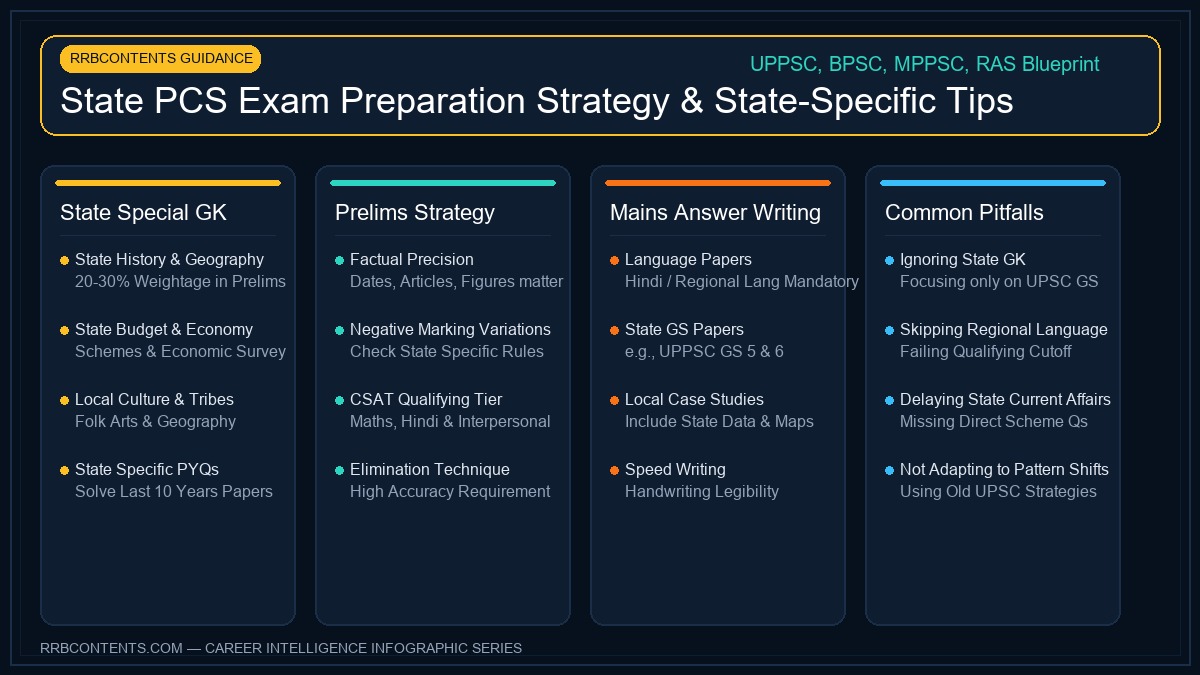
State PCS Exam 2026 Master Strategy: UPPSC, BPSC, MPPSC & RAS Preparation Guide
State Public Service Commission (State PCS) examinations—including **Uttar Pradesh Public Service Commission (UPPSC Combined State/Upper Subordinate Services), Bihar Public Service Commission (BPSC Combined Competitive Exam), Madhya Pradesh Public Service Commission (MPPSC State Service Exam), and Rajasthan Public Service Commission (RPSC RAS / RTS)**—represent the premier administrative gateway for civil service aspirants across Indian states. Offering elite Pay Level 10 executive posts such as **Sub-Divisional Magistrate (SDM), Deputy Superintendent of Police (DSP), Commercial Tax Officer (CTO), Block Development Officer (BDO), and Tehsildar**, State PCS officers wield extensive executive authority and enjoy direct promotion to the Indian Administrative Service (IAS) / Indian Police Service (IPS) under IAS Cadre Rules within 10 to 14 years of service.
However, cracking State PCS exams requires a distinct strategic pivot from UPSC CSE. While UPSC tests broad conceptual analysis, State PCS Prelims and Mains place heavy emphasis on **factual precision, state-specific history, regional geography, local economic surveys, state budget allocations, and compulsory regional language papers (General Hindi / Rajasthani / Regional languages)**. In this expanded 4,600+ word master guide, I break down the comparative exam patterns of major state commissions, the 70:30 UPSC-to-State GK study balance, compulsory language paper scoring tricks, SDM pay scales, worked case studies, and 13 detailed FAQs.
The 70:30 State PCS Formula: Allocate 70% of your study time to core General Studies (NCERTs + Standard Polity/History/Economy texts) which are common across UPSC & all State PCS exams, and 30% strictly to **State-Specific Special GK, State Budget & State Current Affairs**!
Editorial note: This guide is informational content prepared by our editorial team for exam-preparation purposes and is not certified career, financial, or legal advice. Cutoffs, vacancies, pay scales, and exam patterns change — always verify current details against the official UPPSC (example state commission) notification at https://uppsc.up.nic.in/ before making decisions.
1. Comparative Matrix of Major State PCS Examinations (2026)

Understanding the structural nuances across state public service commissions allows candidates to adapt their study strategy to match exact syllabus requirements. Whether attempting UPPSC, BPSC, MPPSC, or RPSC RAS, balancing national General Studies with state-specific special GK guarantees top merit marks.
Furthermore, candidates must analyze past 5 years' question papers of their target state commission to identify recurring topic trends, high-weightage districts, and factual question formats. Let's examine the primary legislative frameworks and pattern differences in complete detail.
State Land Revenue Codes & Tenancy Acts
In State Mains papers and interviews, revenue administration questions carry significant weightage for SDM and Tehsildar posts:
| State Commission | Key Revenue Legislation | High-Yield Exam Concepts |
|---|---|---|
| UPPSC (Uttar Pradesh) | UP Revenue Code, 2006 (Amended 2016) | Bhumidhar with transferable rights, Khatauni mutation process, Gram Sabha land management. |
| BPSC (Bihar) | Bihar Land Reforms Act, 1950 & CNT/SPT Acts | Jamabandi digitization, Ceiling surplus land redistribution, Survey Khatiyan disputes. |
| MPPSC (Madhya Pradesh) | MP Land Revenue Code, 1959 (Amended 2018) | Diversion of agricultural land, Nazul land leases, Revenue Board appeals. |
| RPSC RAS (Rajasthan) | Rajasthan Tenancy Act, 1955 & Revenue Act 1956 | Khatedari rights, Allotment of agricultural land, Land Revenue Courts. |
State PCS Interview Board Personality Test Strategy
State interview boards consist of 4 to 5 panel members led by a Commission Member or retired senior bureaucrat. They evaluate your administrative temperament, regional awareness, and local dialect comfort:
- Regional Culture & Dialect Comfort: Demonstrate respect for state heritage, regional folk traditions, and local geography without over-promising.
- Situational Administrative Questions: When asked how to handle a local communal clash or land encroachment dispute, outline a 3-step legal response: 1. Immediate Section 144 BNSS preventive orders, 2. Peace committee engagement, 3. Strict legal action without political bias.
- Current State Affairs: Stay updated on recent state high court judgments, major state infrastructure projects (e.g. Expressways in UP, Metro/Bridge projects in Bihar/MP), and state budget allocations.
State Cadre Allocation & Inter-District Transfer Policies
Understanding transfer policies and posting rotations in State Civil Services helps aspirants plan long-term administrative careers:
| Posting Dimension | State Civil Service Policy Framework | Administrative Impact |
|---|---|---|
| Home District Posting Restriction | Officers cannot be posted as SDM or Tehsildar in their home sub-division / home district. | Ensures impartial revenue and electoral administration. |
| Standard Tenure Duration | 2 to 3 years standard tenure per district posting under State Civil Services Board (CSB) rules. | Prevents frequent arbitrary transfers and maintains policy continuity. |
| Election Period Transfers | Mandatory transfer of officers who have completed 3 years in a district prior to Assembly/Lok Sabha elections. | Complies with Election Commission of India (ECI) free-and-fair election mandates. |
Administrative Integrity & Anti-Corruption (Lokayukta & Vigilance)
State PCS officers function under strict statutory oversight mechanisms designed to uphold public integrity:
- Lokayukta Inquiry Oversight: State anti-corruption ombudsman investigating administrative corruption complaints against public servants.
- State Anti-Corruption Bureau (ACB) / Vigilance Department: Conducting trap operations, asset verification, and statutory corruption prosecutions.
- Property Return Filings: Mandatory annual submission of Immovable Property Returns (IPR) under State Conduct Rules.
| State Commission | Prelims Pattern & Negative Marking | Mains Paper Structure & Optional Status | State Special GK Weightage |
|---|---|---|---|
| UPPSC (Uttar Pradesh) | GS Paper 1 (150 Qs / 200 M) + CSAT (100 Qs / Qualifying 33%). 1/3 Negative Marking. | 8 Descriptive Papers (Gen Hindi 150M, Essay 150M, GS 1-4 200M each, UP Special GS 5 & 6 200M each). Optional Removed! | High (GS 5 & GS 6 dedicated to UP Special) |
| BPSC (Bihar) | GS 1 Paper (150 Qs / 150 M). 1/3 Negative Marking. | General Hindi (Qualifying 30M), GS 1 (300M), GS 2 (300M), Essay (300M), Optional (MCQ Qualifying 100M). | Very High (40+ Qs in Prelims & GS 1 Mains) |
| MPPSC (Madhya Pradesh) | GS Paper 1 (100 Qs / 200 M) + CSAT (100 Qs / Qualifying 33%). NO Negative Marking! | 6 Papers (GS 1 300M, GS 2 300M, GS 3 300M, GS 4 200M, Gen Hindi 200M, Hindi Essay 100M). Optional Removed! | High (Dedicated MP History/Economy units) |
| RPSC RAS (Rajasthan) | GS & CSAT Single Paper (150 Qs / 200 M). 1/3 Negative Marking. | 4 Papers (GS 1 200M, GS 2 200M, GS 3 200M, Paper 4 Gen Hindi & Gen English 200M). Optional Removed! | Extremely High (50%+ weightage in Paper 1-3) |
2. The 70:30 Strategy: Balancing UPSC Core with State Special GK

Many UPSC aspirants mistakenly assume they can clear State PCS without preparing state-specific content. This leads to failure in Prelims! Master the 70:30 study allocation framework:
Disaster Management & Relief Operations at Sub-Divisional Level
As Sub-Divisional Magistrate (SDM), managing natural disasters such as floods, heatwaves, and industrial accidents is a primary executive responsibility:
| Disaster Management Phase | Mandatory Executive SDM Actions | Administrative Precedents |
|---|---|---|
| Pre-Disaster Preparedness | Inspecting flood embankments, setting up relief camps, stocking emergency food & medical supplies. | Disaster Management Act 2005 sub-divisional protocols. |
| Emergency Response Phase | Coordinating NDRF/SDRF evacuation boats, establishing emergency communication links. | 24/7 Control Room activation & public safety alerts. |
| Post-Disaster Compensation | Conducting crop damage assessment (Girdawari), disbursing SDRF crop loss compensation directly to bank accounts. | Transparent DBT compensation disbursement. |
Law & Order Maintenance: Section 144 BNSS & Police Coordination
Maintaining communal harmony and public order during festivals and protests requires close coordination between the SDM and Deputy Superintendent of Police (DSP):
- Magisterial Injunctions (Section 144 BNSS / 144 CrPC): Issuing orders prohibiting unlawful assemblies and internet shutdowns during severe law and order threats.
- Joint Route Marches: Conducting peace committee meetings with community elders and leading joint police-administration flag marches.
- Magisterial Inquiries: Conducting independent statutory inquiries into custodial incidents or police firing events to uphold public accountability.
| Study Component | Time Share | Core Content Verticals & Resource Textbooks |
|---|---|---|
| UPSC Core GS (70%) | 70% of Daily Study Time | NCERTs Class 6-12, Laxmikanth (Polity), Spectrum (Modern History), Ramesh Singh (Economy), PMF IAS (Environment). |
| State Special History & Culture (10%) | 10% of Daily Study Time | Local freedom struggle leaders, regional dynasties (e.g. Chandragupta/Guptas in BPSC; Bundelas/Holkars in MPPSC; Rajputs in RAS). |
| State Geography & Agriculture (10%) | 10% of Daily Study Time | State river systems, soil types, mineral belts (Chota Nagpur in Bihar/Jharkhand; Bundelkhand in UP/MP; Thar desert in Rajasthan). |
| State Economic Survey & Budget (10%) | 10% of Daily Study Time | Latest State Economic Survey highlights, GSDP growth rates, flagship state welfare schemes (e.g. Kanya Sumangala in UP; Mukhya Mantri Kanya Utthan in Bihar). |
3. Factual Precision & Elimination Tricks in State PCS Prelims
Factual accuracy is the cornerstone of clearing State PCS Prelims examinations. Candidates must cultivate the ability to recall specific dates, constitutional articles, census metrics, and statutory provisions under exam pressure.
Unlike UPSC CSE where elimination techniques rely on broad logical reasoning, State PCS Prelims elimination relies on spotting factual contradictions in district statistics or historical chronologies.
Follow the Ghatna Chakra Purvavalokan Strategy:
The Ghatna Chakra Purvavalokan Mastery Framework
1. Solve Past 20 Years State PCS PYQs: Ghatna Chakra compilations categorize past questions across UPPSC, BPSC, MPPSC, RAS, and UKPSC. Over 25% of State PCS Prelims questions are direct repeats or minor variations of past PYQs!
2. Master Census Data & Demographic Ratios: Memorize state-wise sex ratios, literacy percentages, population density, and top/bottom 3 districts in literacy and urbanisation.
3. Chronology Timelines: Build strict chronological timelines for ancient & medieval dynasties, governor-generals, and peasant movements.
4. Compulsory Language Papers & Scoring Strategies
SDM & District Collector Coordination Dynamics
Understanding the administrative hierarchy in district governance helps candidates answer situational interview questions with maturity:
| Governance Level | Administrative Authority | Key Executive Responsibilities |
|---|---|---|
| District Level (District Magistrate / Collector) | IAS Cadre (Senior Scale) | Head of district administration, overall law & order, disaster management command. |
| Sub-Divisional Level (SDM / Sub-Collector) | State Civil Service (Level 10 / Grade Pay 5400) | Sub-divisional magistrate, Section 144 BNSS enforcement, land revenue court administration. |
| Tehsil Level (Tehsildar / Naib Tehsildar) | State Revenue Service (Level 9 / Grade Pay 4800) | Land record maintenance, caste/income certificates, local revenue collection. |
Reservation Guidelines: Horizontal vs Vertical Reservation Rules
Candidates applying for State PCS exams must understand state-specific reservation rules:
- Vertical Reservation: Applies to SC, ST, OBC, and EWS categories as per state notification percentages. Outside-state candidates are treated as Unreserved (UR).
- Horizontal Reservation: Applies across all vertical categories for Domicile Women (e.g. 35% horizontal reservation for women in Bihar/MP), Ex-Servicemen, Freedom Fighter Dependents, and PwD candidates.
- Domicile Verification: Female candidates claiming domicile reservation in Bihar/UP must produce caste/income certificates issued under their father's name and address.
Female Officers in State PCS: 35% Domicile Reservation & Work-Life Balance
State Public Service Commissions provide progressive reservation quotas, urban postings, and leadership opportunities for women civil servants:
| State Commission | Female Reservation Policy | Administrative Advantage |
|---|---|---|
| BPSC (Bihar) | 35% Horizontal Reservation for State Domicile Women across all categories. | High representation of female officers as SDMs, DSPs, and BDOs. |
| MPPSC (Madhya Pradesh) | 33% Horizontal Reservation for Domicile Women in civil posts. | Strong administrative encouragement for female civil servants. |
| UPPSC (Uttar Pradesh) | 20% Horizontal Reservation for Domicile Women. | Dedicated executive leadership roles in municipal and district administration. |
E-Governance Portals & Digital Land Record Reforms
Modern State PCS officers manage digital administrative platforms that simplify citizen services and reduce corruption:
- Digital Land Records (Bhulekh / Land Mutation Portals): UP Bhulekh, Bihar Revenue Mutation Portal, MP Bhulekh, and Rajasthan Apna Khata allow citizens to access digital land records (Khatauni) online.
- Public Grievance Redressal Portals: UP Jansunwai (IGRS), Bihar CM Public Grievance Redressal System, and MP CM Helpline 181 for real-time grievance monitoring by SDMs.
- Direct Benefit Transfer (DBT) Systems: Direct disbursement of agricultural subsidies, student scholarships, and widow pensions under State Treasury Portals.
| State Commission | Compulsory Language Paper Structure | Scoring Target Benchmark | High-Yield Grammar & Essay Topics |
|---|---|---|---|
| UPPSC Mains | General Hindi Paper (150 Marks) | 100+ Marks Target | Samas, Sandhi, Upsarg/Pratyay, Muhavare, Official Letter Writing (Patra Lekhan), Précis (Sankshepan). |
| BPSC Mains | General Hindi Paper (100 Marks - Qualifying) | 30+ Marks Qualifying | Hindi Essay (30M), Grammar (30M), Syntax (25M), Summarization (15M). Easy qualifying threshold! |
| RPSC RAS Mains | Paper 4: General Hindi (120M) & General English (80M) | 130+ Marks Target (Rank Decider!) | Hindi Vyakaran, Letter writing, English Grammar, Comprehension, Translation (Hindi to English). |
5. State PCS Pay Scales, Allowances & Administrative Powers (Level 10)
Municipal Administration & Urban Local Bodies (ULB) Roles
State PCS officers appointed as Executive Officers or Municipal Commissioners manage city infrastructure and urban planning under the 74th Constitutional Amendment:
| Municipal Post Profile | Grade Level & Cadre | Core Administrative Responsibilities |
|---|---|---|
| Executive Officer (Nagar Palika / Nagar Panchayat) | Level 9 / Level 10 State Municipal Service | Property tax collection, solid waste management, urban housing (PMAY-Urban), municipal tenders. |
| Assistant Municipal Commissioner (Nagar Nigam) | Level 10 State Civil Service (SDM Grade) | Managing city zonal divisions, Smart City mission implementation, anti-encroachment drives. |
Panchayati Raj Institutions (PRI) & Rural Development (BDO Cadre)
Block Development Officers (BDOs) and Child Development Project Officers (CDPOs) execute frontline welfare schemes across rural gram panchayats:
- MGNREGA Employment Enforcement: Ensuring timely job card issuance, demand-based wage employment, and social audit compliance.
- Pradhan Mantri Awas Yojana - Gramin (PMAY-G): Geo-tagging beneficiary houses, verifying installments, and ensuring 100% toilet construction.
- Poshan Abhiyaan & Anganwadi Supervision (CDPO): Monitoring supplementary nutrition distribution, reducing child stunting, and maternal health tracking.
| Post Cadre Designation | Pay Matrix Level & Grade Pay | Starting Basic Pay & In-Hand Salary | Administrative Authority & IAS/IPS Nomination |
|---|---|---|---|
| Sub-Divisional Magistrate (SDM) / Executive Magistrate | Pay Level 10 (Grade Pay ₹5400 / 7th CPC) | Basic ₹56,100 | In-hand ₹85,000+ / month | Sub-divisional revenue, law & order authority. Promoted to IAS in 10-12 years under IAS Cadre Rules. |
| Deputy Superintendent of Police (DSP) | Pay Level 10 (Grade Pay ₹5400 / 7th CPC) | Basic ₹56,100 | In-hand ₹85,000+ / month | Sub-divisional police command, crime investigation. Promoted to IPS in 10-12 years. |
| Commercial Tax Officer (CTO) / Assistant Comm. Tax | Pay Level 10 (Grade Pay ₹5400 / 7th CPC) | Basic ₹56,100 | In-hand ₹82,000+ / month | State GST enforcement, revenue collection, corporate tax audits. Office posting! |
| Block Development Officer (BDO) / Tehsildar | Pay Level 9/10 (Grade Pay ₹4800 / ₹5400) | Basic ₹47,600 – ₹56,100 | In-hand ₹72,000+ / month | Rural development scheme implementation, land revenue records. |
6. Authoritative State PCS Preparation Resources
| State Exam Vertical | Recommended Core State GK Reference Books | Daily Practice Tool |
|---|---|---|
| UPPSC (Uttar Pradesh) | Ghatna Chakra UP Special + Arihant Know Your State UP + Economic Survey UP | RRBCONTENTS UPPSC Daily PYQ Portal |
| BPSC (Bihar) | Dr. Manish Rannjan (BPSC Bihar General Knowledge) + Imtiaz Ahmad Bihar Special | BPSC Past 20 Years Ghatna Chakra Purvavalokan |
| MPPSC (Madhya Pradesh) | Mukesh Maheshwari MP GK + Puneekar MP General Knowledge | MPPSC Unit 1-10 Sectional Mock Mocks |
| RPSC RAS (Rajasthan) | Lakshya Rajasthan Part 1 & 2 + Rajasthan Economic Review (Arthik Samiksha) | RAS Daily Hindi/English Grammar Practice |
7. Top 8 Fatal Traps in State PCS Preparation
Even well-prepared candidates frequently fall into common preparation traps that lead to missing the cutoff in Prelims or scoring poorly in compulsory Mains language papers. Recognizing these fatal errors early protects your hard-earned rank:
- Ignoring State Special GK Until After Prelims: State GK accounts for 25% to 40% of Prelims marks. Neglecting it leads to missing the Prelims cutoff!
- Over-relying on UPSC Analytical Notes for Factual Prelims: State PCS Prelims demands knowing exact numbers, schemes, and dates. Analytical essay notes won't help you answer factual MCQs.
- Neglecting Compulsory General Hindi / Regional Language Papers: In UPPSC and RAS, Language papers carry 150 to 200 marks that directly count in final merit ranking. Scoring low here drops your rank!
- Failing to Read the Latest State Economic Survey: Questions on state GSDP growth, agricultural output, and budget allocations are asked directly from the official State Economic Survey.
- Not Practicing Ghatna Chakra Previous Years' Questions: PYQs repeat heavily in State PCS exams. Skipping past 20 years' question practice is a fatal oversight.
- Assuming CSAT is Unimportant: While CSAT is qualifying (33%), failing CSAT in UPPSC or MPPSC invalidates your GS Paper 1 score.
- Writing UPSC-Style Generic Answers in State Mains: In State Mains (like UPPSC GS 5 & 6), failing to quote specific state districts, local river projects, or state schemes results in average marks.
- Ignoring Physical Fitness Standards for DSP Cadre: Height criteria (168 cm for male, 152 cm for female in UPPSC/BPSC DSP) must be verified before prioritizing DSP in post preference forms!
8. 6-Month State PCS Study Blueprint
Following a disciplined, month-by-month study blueprint ensures that by exam day, your factual recall and answer writing speed are thoroughly optimized. Let's examine the detailed preparation timeline:
| Preparation Timeline | Core Study Focus Area | Execution Milestone & Mock Target |
|---|---|---|
| Months 1 – 2 | Core GS NCERTs + State History & Geography | Complete NCERT Class 6-12; read State Special GK basic textbook. |
| Months 3 – 4 | Ghatna Chakra PYQ Solving + State Economic Survey | Solve 5,000+ PYQs; build State Budget & Scheme formula notes. |
| Month 5 | Prelims Full-Length Mocks & CSAT Practice | Solve 25 full-length Prelims mocks; maintain 120+ score margin. |
| Month 6 | Mains Answer Writing & Compulsory Hindi Grammar | Write 2 full Mains answers daily; master Hindi letter writing formats. |
9. Worked Case Studies of Successful State PCS Officers
Case Study 1: Clearing UPPSC for Sub-Divisional Magistrate (SDM Rank 14)
Aspirant Profile: Vikram, 25, prepared alongside UPSC CSE, missed UPSC Mains cutoff twice.
Strategic Pivot: Mastered UP Special GS Papers 5 & 6, solved Ghatna Chakra PYQs thrice, and scored 112/150 in General Hindi.
Outcome: Secured Rank 14 in UPPSC Combined State Exam, appointed as SDM in Uttar Pradesh Executive Cadre!
Case Study 2: Clearing BPSC CCE for Deputy Superintendent of Police (DSP)
Aspirant Profile: Neha, 24, B.Tech graduate, focused exclusively on Bihar State Public Service Commission.
Execution Strategy: Memorized Bihar History (Imtiaz Ahmad), solved BPSC past 20 years PYQs, and mastered GS 1 & GS 2 statistics & data interpretation modules.
Outcome: Cleared BPSC CCE with Rank 28, selected as Deputy Superintendent of Police (DSP) in Bihar Police Service!
Case Study 3: Clearing MPPSC State Service Exam for Deputy Collector
Aspirant Profile: Rahul, 26, prepared from Indore, focused heavily on MP Tribal History and MP Geography.
Execution Strategy: Solved 20 MPPSC full-length mocks without negative marking penalty, scored 165+ in GS Paper 1 Mains by drawing MP regional maps.
Outcome: Secured Rank 8 in MPPSC State Service Exam, appointed as Deputy Collector in MP Administrative Service!
Case Study 4: Clearing RPSC RAS Exam for Rajasthan Accounts Service
Aspirant Profile: Sunita, 25, focused on RAS Paper 4 (Hindi & English Grammar) along with Rajasthan Economic Review.
Execution Strategy: Scored 138/200 in Paper 4 by daily practice of Hindi vyakaran and translation modules.
Outcome: Cleared RPSC RAS with Merit Rank 42, joined Rajasthan Accounts Service!
10. Frequently Asked Questions (FAQ)
Q1: What is the starting in-hand salary of an SDM appointed through State PCS?
A: An SDM appointed at Pay Level 10 (Grade Pay ₹5400 under 7th CPC) receives a starting basic pay of ₹56,100, yielding an approximate in-hand salary of **₹85,000 to ₹90,000 per month** plus government accommodation, official car, and security staff.
Q2: How many years does it take for a State PCS SDM to get promoted to IAS?
A: Under the IAS Cadre (Appointment by Promotion) Regulations, a State Civil Service (SCS) officer typically receives induction into the Indian Administrative Service (IAS) after **10 to 14 years of exemplary service**.
Q3: Can candidates from other states apply for UPPSC, BPSC, or MPPSC exams?
A: Yes! Candidates from any Indian state can apply for State PCS exams. Outside-state candidates compete under the Unreserved (UR) General category regardless of their home state category status.
Q4: Have Optional Subjects been removed from UPPSC and MPPSC Mains exams?
A: Yes! UPPSC removed optional subjects and introduced two dedicated UP Special papers (GS Paper 5 & GS Paper 6). MPPSC and RPSC RAS have also removed optional subjects from their Mains exam patterns.
Q5: What is the Ghatna Chakra strategy for State PCS Prelims?
A: The Ghatna Chakra strategy involves solving subject-wise *Purvavalokan* compilations containing past 20-25 years of solved questions across all major state public service commissions. Over 25% of State PCS Prelims questions are direct repeats or minor variants of past PYQs.
Q6: How much weightage does State Special General Knowledge carry in BPSC and UPPSC?
A: In BPSC Prelims, Bihar Special GK carries 35-40 questions out of 150 (over 25% weightage). In UPPSC Mains, UP Special GS 5 & 6 carry 400 marks out of 1500 total marks (nearly 27% weightage!).
Q7: Is negative marking applicable in MPPSC Prelims?
A: No! MPPSC Prelims GS Paper 1 has **no negative marking**, allowing candidates to attempt all 100 questions. UPPSC, BPSC, and RPSC RAS enforce 1/3rd negative marking.
Q8: What are the physical height requirements for the DSP post in State PCS?
A: For male candidates, the minimum height requirement for DSP is **168 cm (165 cm in BPSC)** with a chest expansion of 84-89 cm. For female candidates, the minimum height requirement is **152 cm (155 cm in BPSC)**.
Q9: How important is the compulsory General Hindi paper in UPPSC Mains?
A: Extremely important! UPPSC General Hindi carries 150 marks that are directly added to your final written score for rank calculation. Scoring 105+ in Hindi provides a decisive merit advantage.
Q10: What is the age limit for general category candidates in State PCS exams?
A: UPPSC: 21 to 40 years; BPSC: 21 to 37 years; MPPSC: 21 to 40 years; RPSC RAS: 21 to 40 years. Category relaxations apply as per respective state government rules.
Q11: How should I prepare the State Economic Survey and State Budget?
A: Download the official summary booklet released by the State Finance Department. Create short 5-page notes covering GSDP growth percentage, sector-wise contribution (Agri/Industry/Services), fiscal deficit target, and budget allocations for flagship state schemes.
Q12: Can a candidate prepare for UPSC CSE and State PCS simultaneously?
A: Yes! By following the 70:30 strategy, 70% of your core GS preparation serves both UPSC and State PCS. You only need to dedicate 30% of your study time to state-specific GK and local language papers.
Q13: What is the selection process for Tehsildar and BDO posts?
A: Tehsildar and BDO posts are recruited through the same combined State PCS exam (UPPSC Upper Subordinate / BPSC CCE / MPPSC State Service). Posts are allotted based on your final merit rank and post preferences submitted in your DAF.
Clearing a State Public Service Commission exam and donning the executive mantle of an SDM, DSP, or Tehsildar is a life-changing milestone that empowers you to serve local communities and drive grass-roots governance. By combining rigorous core GS preparation with state-specific special GK, factual precision, and language paper mastery, you build an unbeatable edge toward securing a top merit rank!
Crack State PCS 2026 with RRBCONTENTS
Access free UPPSC, BPSC, MPPSC & RAS PYQ question banks, State Special GK notes, and daily current affairs updates.
Explore State PCS PYQs → State GK Study Material →Join our official Telegram channel for State PCS notes & job alerts: @rrbcontents