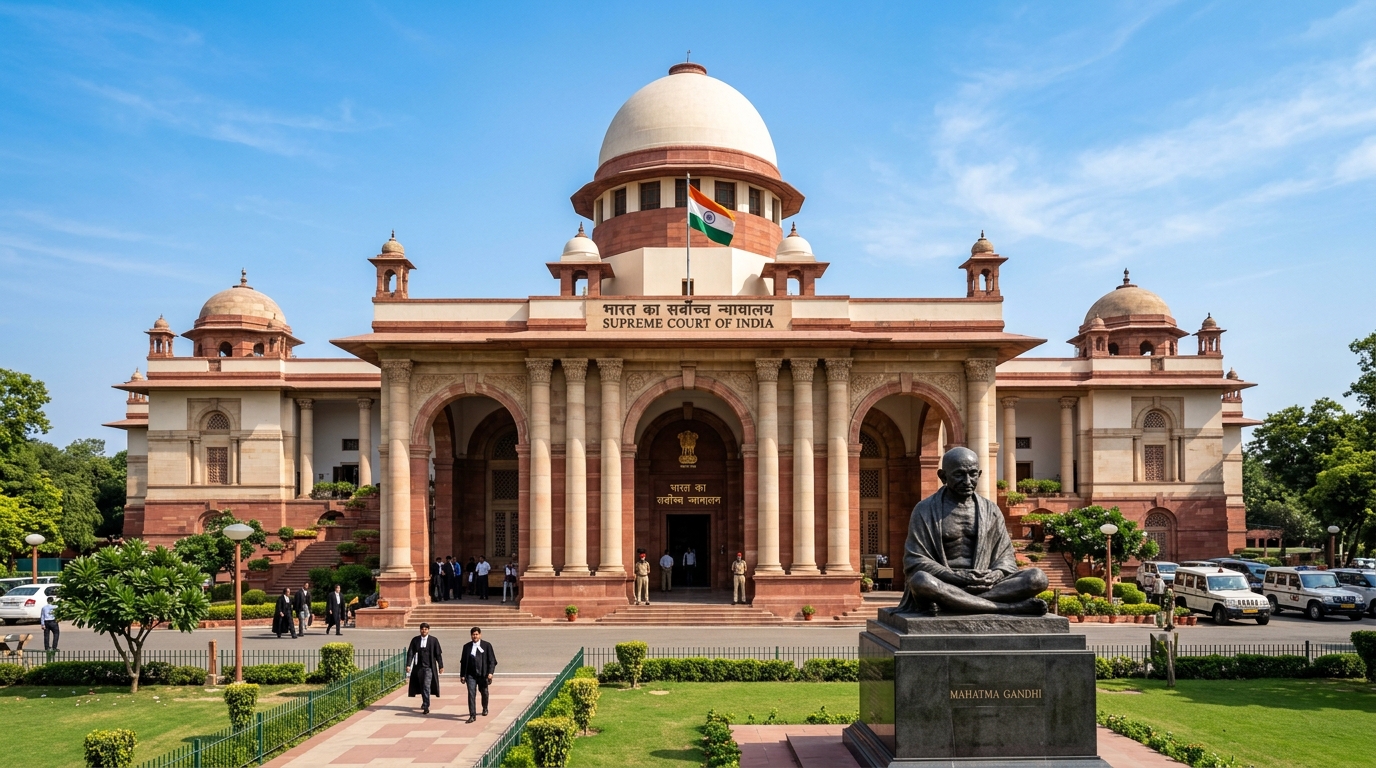
SUPREME COURT OF INDIA: JURISDICTION, PUBLIC INTEREST LITIGATION (PIL), JUDICIAL REVIEW & LANDMARK JUDGMENTS (COMPLETE GUIDANCE FOR COMPETITIVE EXAMS)
Chapter 1
INTRODUCTION
The Supreme Court of India is the apex judicial tribunal, the highest constitutional court, the final court of appeal, and the ultimate guarantor of Fundamental Rights and constitutional democracy in India. Inaugurated on 28th January 1950 (two days after India became a Sovereign Democratic Republic), the Supreme Court replaced both the Federal Court of India (established under the Government of India Act 1935) and the Judicial Committee of the Privy Council in London.
Under Part V (Chapter IV - The Union Judiciary) of the Constitution of India, Article 124(1) establishes: "There shall be a Supreme Court of India consisting of a Chief Justice of India and, until Parliament by law prescribes a larger number, of not more than seven other Judges." Today, through successive Parliamentary enactments, the sanctioned strength of the Supreme Court stands at 34 Judges (1 Chief Justice of India + 33 Supreme Court Judges).
Functioning under the motto “Yato Dharmastato Jayaḥ” ("Where there is righteousness, there is victory"), the Supreme Court exercises extraordinary constitutional authority. Through its original, appellate, advisory, and writ jurisdictions, as well as its powers of Judicial Review and Public Interest Litigation (PIL), the Indian judiciary has emerged as one of the most powerful and activist judicial institutions in the world.
For aspirants preparing for UPSC Civil Services, State Judicial Services, State PSCs (UPPSC, BPSC, MPPSC, RAS), SSC CGL, and law entrance exams (CLAT PG), mastering the legal provisions, Collegium system, writ procedures, landmark judgments, and recent judicial reforms is essential.
This comprehensive master career guide provides an exhaustive breakdown of the Supreme Court of India. We cover every legal detail—from constitutional articles and Collegium appointment rules to Article 32 writs, Article 142 'Complete Justice' powers, PIL origins, judicial review principles, 20 landmark judgments, comparative jurisdiction tables, 12 exam-focused FAQs, and essential memory tools.
---
Chapter 2
HISTORICAL EVOLUTION OF THE INDIAN JUDICIARY
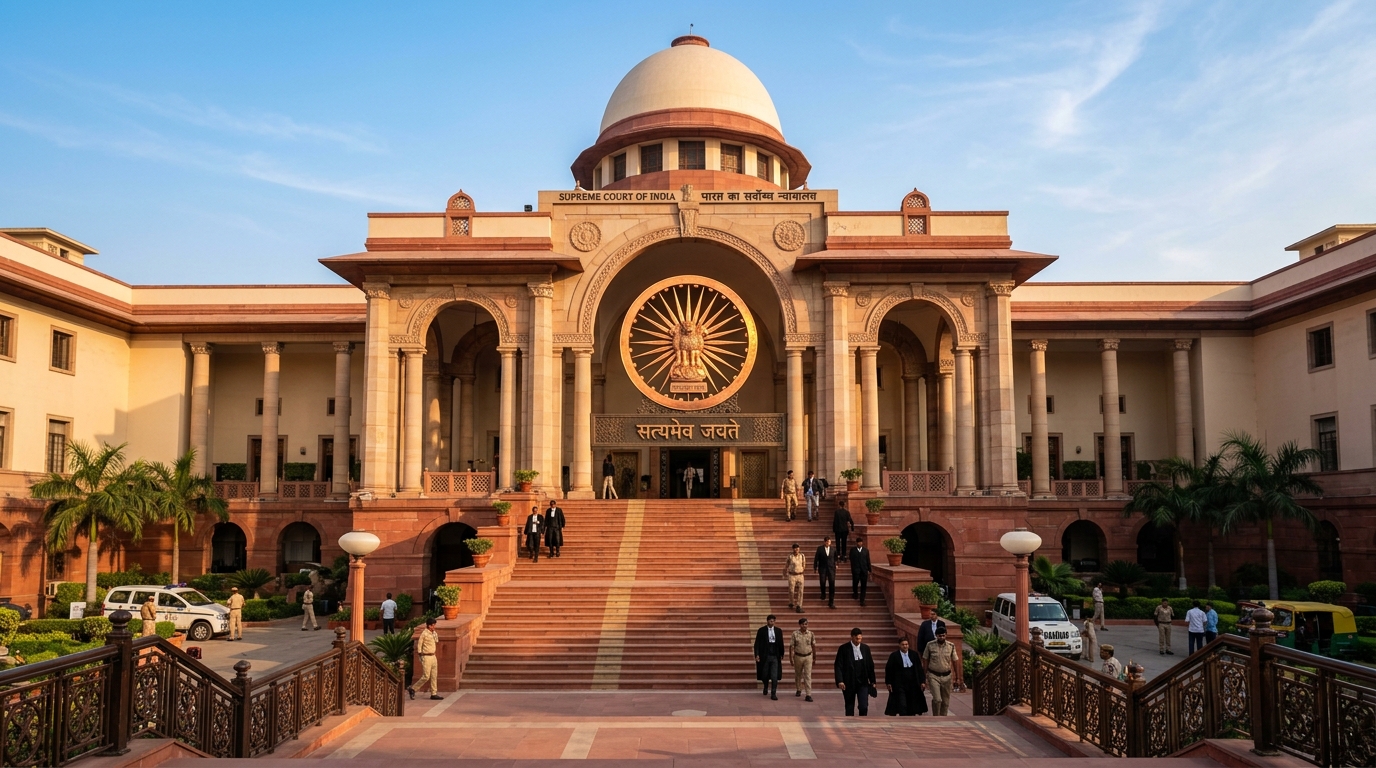
HISTORICAL EVOLUTION OF THE INDIAN JUDICIARY - Illustrative Reference
Supreme Court of Judicature at Fort William (Calcutta) (Regulating Act 1773)
       │
       ▼ (High Courts Act 1861)
High Courts of Calcutta, Bombay, and Madras Established
       │
       ▼ (Government of India Act 1935)
Federal Court of India Established at New Delhi (1937)
       │
       ▼ (28th January 1950 - Post-Independence)
Supreme Court of India Inaugurated (Replaced Federal Court & Privy Council Appeals)
- Regulating Act of 1773: Established the Supreme Court of Judicature at Calcutta (Sir Elijah Impey as 1st Chief Justice).
- Government of India Act 1935: Created the Federal Court of India in 1937, which had original jurisdiction in inter-provincial disputes and appellate jurisdiction from High Courts. Appeals still lay to the Judicial Committee of the Privy Council in London.
- Abolition of Privy Council Jurisdiction Act, 1949: Terminated all appeals to the British Privy Council, transferring full judicial sovereignty to the Supreme Court of India.
---
Chapter 3
CONSTITUTIONAL ARTICLES AT A GLANCE (ARTICLES 124 TO 147)
Part V (Chapter IV) of the Indian Constitution outlines the structural, procedural, and jurisdictional provisions governing the Apex Court from Article 124 to Article 147.
| Constitutional Article | Subject Matter / Provisions |
|---|---|
| Article 124 | Establishment and composition of the Supreme Court, appointment & removal of judges. |
| Article 125 | Salaries, allowances, and pensions of Supreme Court Judges. |
| Article 126 | Appointment of Acting Chief Justice of India by the President. |
| Article 127 | Appointment of Ad-Hoc Judges in Supreme Court (by CJI with President's consent). |
| Article 128 | Attendance of retired Judges at sittings of the Supreme Court. |
| Article 129 | Supreme Court to be a Court of Record (Power to punish for contempt of itself). |
| Article 130 | Seat of Supreme Court (New Delhi, or other places appointed by CJI with President's approval). |
| Article 131 | Original Jurisdiction of Supreme Court (Centre-State & Inter-State disputes). |
| Article 132 | Appellate Jurisdiction in constitutional matters. |
| Article 133 | Appellate Jurisdiction in civil matters. |
| Article 134 | Appellate Jurisdiction in criminal matters. |
| Article 134A | Certificate for appeal to the Supreme Court issued by High Courts. |
| Article 136 | Special Leave Petition (SLP) (Extraordinary discretionary power to grant leave to appeal). |
| Article 137 | Review of judgments or orders by the Supreme Court. |
| Article 138 | Enlargement of the jurisdiction of the Supreme Court by Parliament. |
| Article 139 | Conferment on Supreme Court of powers to issue certain writs (beyond Art 32). |
| Article 139A | Transfer of certain cases from High Courts to Supreme Court. |
| Article 140 | Ancillary powers of Supreme Court conferred by Parliament. |
| Article 141 | Law declared by Supreme Court to be binding on all courts within India. |
| Article 142 | Enforcement of decrees/orders of SC and orders as to discovery ("Complete Justice"). |
| Article 143 | Advisory Jurisdiction of Supreme Court (Presidential reference). |
| Article 144 | Civil and judicial authorities to act in aid of the Supreme Court. |
| Article 145 | Rules of Court, Bench sizes (Minimum 5 Judges for Constitutional Benches). |
| Article 146 | Officers, servants, and expenses of the Supreme Court. |
---
Qualifications for Appointment as a Supreme Court Judge (Article 124(3)):
- 1. Has been a Judge of a High Court (or of two or more such courts in succession) for at least 5 years; OR
- 2. Has been an Advocate of a High Court (or of two or more such courts in succession) for at least 10 years; OR
- 3. Is, in the opinion of the President, a Distinguished Jurist. (Note: No person has been appointed directly under the 'distinguished jurist' category to date).
1st Judges Case (1981 - SP Gupta Case)
       │
       ▼
2nd Judges Case (1993 - Supreme Court Advocates-on-Record Association)
       │
       ▼
3rd Judges Case (1998 - Presidential Reference)
       │
       ▼
4th Judges Case (2015 - NJAC Unconstitutional)
- Current Appointment Procedure: The President appoints Supreme Court Judges on the recommendation of the Supreme Court Collegium comprising the Chief Justice of India (CJI) and four senior-most Judges of the Supreme Court.
- Supreme Court Judges hold office until attaining the age of 65 years.
- Can resign at any time by writing to the President of India.
Chapter 9
# 4. Procedure for Removal of a Judge (Article 124(4) & Judges Inquiry Act 1968):
A Supreme Court Judge can be removed from office ONLY by an order of the President passed after an address by Parliament in the same session.
- Grounds for Removal: (1) Proved Misbehavior, or (2) Incapacity.
- Procedure under Judges Inquiry Act, 1968:
Chapter 10
1. Removal motion must be signed by 100 members of Lok Sabha OR 50 members of Rajya Sabha and presented to the Speaker/Chairman.
Chapter 11
2. Speaker/Chairman may admit or reject the motion.
Chapter 12
3. If admitted, a 3-Member Committee is constituted to investigate charges:
- Chief Justice of India or an SC Judge.
- Chief Justice of a High Court.
- A Distinguished Jurist.
Chapter 13
4. If the Committee finds the judge guilty, the motion is taken up for voting in both Houses of Parliament.
- Majority of total membership of the House, AND
- Majority of not less than two-thirds (2/3rd) of members present and voting.
Chapter 14
6. President signs the removal order. (No Supreme Court Judge has been impeached and removed to date).
---
Chapter 15
COMPREHENSIVE JURISDICTION AND POWERS OF THE SUPREME COURT
Jurisdictions & Powers of Supreme Court of India
├── 1. Original Jurisdiction (Article 131 - Inter-Governmental Disputes)
├── 2. Writ Jurisdiction (Article 32 - Enforcement of Fundamental Rights)
├── 3. Appellate Jurisdiction (Articles 132-134A - Constitutional, Civil, Criminal)
├── 4. Special Leave Petition / SLP (Article 136 - Discretionary Appeals)
├── 5. Advisory Jurisdiction (Article 143 - Presidential Consultation)
├── 6. Court of Record & Contempt Powers (Article 129)
├── 7. Power of Judicial Review (Articles 13, 32, 136, 141, 142)
└── 8. Complete Justice Power (Article 142)
---
- Disputes between the Government of India and one or more States.
- Disputes between the Government of India and any State(s) on one side and one or more States on the other.
- Disputes between two or more States.
- Exclusions from Article 131: Disputes arising out of pre-Constitution treaties/agreements, inter-state river water disputes (Art 262), Finance Commission matters, and commercial disputes.
---
Article 32 confers original and mandatory writ jurisdiction on the Supreme Court for enforcing Fundamental Rights. Dr. B.R. Ambedkar called Article 32 "the very heart and soul of the Constitution."
| Writ Name | Literal Latin Meaning | Purpose & Grounds for Issuance | Against Whom Issued |
|---|---|---|---|
| Habeas Corpus | "You shall have the body" | Protects personal liberty against illegal detention. Directs authority to produce detained person in court. | Public Authorities & Private Individuals. |
| Mandamus | "We Command" | Commands a public official or body to perform a mandatory statutory duty that they failed/refused to perform. | Public Authorities & Judicial Bodies. (NOT against President/Governor). |
| Prohibition | "To forbid" | Issued by higher court to lower court/tribunal to prevent it from exceeding its jurisdiction. | Judicial & Quasi-Judicial Authorities ONLY. |
| Certiorari | "To be certified" | Quashes an order already passed by a lower court/tribunal acting without jurisdiction or violating natural justice. | Judicial, Quasi-Judicial & Administrative Authorities. |
| Quo-Warranto | "By what authority?" | Inquires into legality of a person's claim to a public office, preventing illegal usurpation. | Public Offices of Substantive Character. |
---
1. Constitutional Matters (Article 132): Appeal lies if the High Court certifies (under Article 134A) that the case involves a substantial question of law as to the interpretation of the Constitution.
2. Civil Matters (Article 133): Appeal lies if the High Court certifies that the case involves a substantial question of law of general importance.
3. Criminal Matters (Article 134): Appeal lies if High Court has on appeal reversed an acquittal order and sentenced accused to death, or withdrawn a case from lower court and sentenced accused to death.
---
Article 136 confers an extraordinary, discretionary constitutional power on the Supreme Court to grant special leave to appeal from any judgment, decree, determination, sentence, or order in any cause or matter passed by any court or tribunal in India.
- Exception: Does NOT apply to judgments passed by Military Courts / Court Martials.
---
1. Question of Law/Fact of Public Importance: President may seek opinion. The Supreme Court MAY or MAY NOT give its opinion.
2. Pre-Constitution Treaties/Agreements: President seeks opinion. The Supreme Court MUST give its opinion.
- Nature of Advice: The advisory opinion rendered by the Supreme Court is purely advisory and NOT binding on the President.
---
Court of Record Powers (Article 129):
- 1. All judgments, records, and proceedings are preserved as permanent evidentiary records and possess binding precedent value (Article 141).
- 2. Has the power to punish for Contempt of Court (both Civil Contempt for willful disobedience, and Criminal Contempt for scandalizing the court), under the Contempt of Courts Act, 1971.
---
Chapter 18
# 7. POWER OF JUDICIAL REVIEW
Judicial Review is the power of the Supreme Court to examine the constitutional validity of legislative enactments and executive orders passed by both Central and State Governments.
- Constitutional Basis: Articles 13, 32, 136, 141, 142, and 226.
- Basic Structure Status: In Minerva Mills (1980) and L. Chandra Kumar (1997), Judicial Review was declared an inviolable part of the Basic Structure of the Constitution.
- Standard of Review: If a law violates Fundamental Rights (Part III), exceeds legislative competence (Schedule VII), or breaches the Basic Structure, the Supreme Court strikes it down as ultra vires and void ab initio.
---
1. Live Streaming of Constitution Bench Proceedings: Following the Swapnil Tripathi v. Supreme Court of India (2018) judgment, the Supreme Court officially commenced live-streaming of all Constitution Bench hearings on YouTube, allowing millions of citizens and law students to observe constitutional arguments in real time.
2. FASTER & SUVAS AI Portals:
- FASTER (Fast and Secured Transmission of Electronic Records): Ensures swift digital transmission of bail and stay orders directly to prison authorities to prevent delayed release of inmates.
- SUVAS (Supreme Court Vidhik Anuvaad Software): AI-trained translation tool translating legal judgments into regional Indian languages (Hindi, Tamil, Gujarati, Marathi, etc.).
3. e-Courts Project & Paperless Benches: Digitization of case records, e-filing portals, and paperless electronic display boards across Supreme Court courtrooms.
Article 142(1) empowers the Supreme Court to pass any decree or order necessary for doing "Complete Justice" in any cause or matter pending before it.
- Significance: Enables the Supreme Court to transcend procedural laws to protect human rights, order environmental cleanups, release prisoners, or resolve complex constitutional deadlocks. (Examples: Union Carbide Bhopal Gas Leak settlement, Ayodhya Temple land title resolution, release of Rajiv Gandhi assassination convicts).
---
- Review Petition (Article 137): A party aggrieved by a Supreme Court judgment can file a Review Petition within 30 days. It is considered by the same Bench in chambers without oral arguments unless special permission is granted.
- Curative Petition (Rupa Ashok Hurra v. Ashok Hurra, 2002): The final judicial recourse created by the Supreme Court to prevent abuse of process and cure gross miscarriage of justice. A Curative Petition can be filed after a Review Petition is dismissed, requiring certification by a Senior Advocate that principles of natural justice were violated.
Chapter 19
PUBLIC INTEREST LITIGATION (PIL) IN INDIA
Public Interest Litigation (PIL) is a revolutionary judicial tool created by the Indian Supreme Court to democratize access to justice for the poor, marginalized, and disadvantaged sections of society.
Traditional Litigation vs Public Interest Litigation (PIL)
└── PIL Relaxation of Locus Standi: ANY public-spirited citizen or NGO can file a petition
- Developed in the late 1970s and early 1980s by visionary Supreme Court judges—primarily Justice V.R. Krishna Iyer and Justice P.N. Bhagwati.
- Hussainara Khatoon v. State of Bihar (1979): Recognized as the First PIL Case in India, exposing the plight of thousands of undertrial prisoners rotting in Bihar jails, leading to the immediate release of over 40,000 undertrials.
- S.P. Gupta v. Union of India (1981): Justice P.N. Bhagwati formally codified PIL principles, holding that any public-spirited individual can approach the court via letters or postcards (Epistolary Jurisdiction).
Chapter 20
1. Bonded labor and child labor rescue.
Chapter 21
2. Undertrial prisoner rights and custodial violence.
Chapter 22
3. Environmental protection and pollution control.
Chapter 23
4. Sexual harassment at workplace (Vishaka Guidelines 1997).
---
Chapter 24
20 LANDMARK SUPREME COURT JUDGMENTS (MUST-KNOW FOR EXAMS)
| # | Landmark Case Name | Year | Supreme Court Ruling & Constitutional Impact |
|---|---|---|---|
| :-: | :--- | :--- | :--- |
| 1 | AK Gopalan v. State of Madras | 1950 | Narrow interpretation of Art 21; held 'Procedure established by law' requires only statutory procedure. |
| 2 | Shankari Prasad v. Union of India | 1951 | Upheld 1st Amendment; held Parliament can amend any part of Constitution including Fundamental Rights. |
| 3 | Golaknath v. State of Punjab | 1967 | Reversed earlier view; held Fundamental Rights are transcendental and Parliament CANNOT amend Part III. |
| 4 | Kesavananda Bharati v. State of Kerala | 1973 | 13-Judge Bench established Basic Structure Doctrine. Parliament can amend Constitution but cannot alter Basic Structure. |
| 5 | ADM Jabalpur v. Shivkant Shukla | 1976 | (Habeas Corpus Case) Notorious ruling suspending Art 21 during 1975 Emergency. (Overruled in Puttaswamy 2017). |
| 6 | Maneka Gandhi v. Union of India | 1978 | Expanded Art 21; read 'Procedure established by law' as 'Due Process of Law' (Fair, Just & Reasonable). |
| 7 | Hussainara Khatoon v. State of Bihar | 1979 | First PIL in India; declared Right to Speedy Trial a Fundamental Right under Article 21. |
| 8 | Minerva Mills v. Union of India | 1980 | Reaffirmed Basic Structure; held harmony between Fundamental Rights and DPSPs is a basic feature. |
| 9 | SP Gupta v. Union of India | 1981 | (First Judges Case) Formally codified PIL principles and relaxed traditional locus standi. |
| 10 | MC Mehta v. Union of India | 1987 | (Oleum Gas Leak Case) Formulated the Principle of Absolute Liability for hazardous industries. |
| 11 | Indra Sawhney v. Union of India | 1992 | (Mandal Case) Upheld 27% OBC quota; capped total reservations at 50%; introduced 'Creamy Layer'. |
| 12 | S.R. Bommai v. Union of India | 1994 | Subjected Article 356 (President's Rule) to Judicial Review; declared Secularism a Basic Feature. |
| 13 | Vishaka v. State of Rajasthan | 1997 | Laid down guidelines against workplace sexual harassment (led to POSH Act 2013). |
| 14 | L. Chandra Kumar v. Union of India | 1997 | Declared Judicial Review under Art 226/32 an inviolable part of Basic Structure. |
| 15 | NALSA v. Union of India | 2014 | Recognized Transgender persons as 'Third Gender' with fundamental rights. |
| 16 | Shreya Singhal v. Union of India | 2015 | Struck down Section 66A of IT Act 2000 for violating free speech under Art 19(1)(a). |
| 17 | KS Puttaswamy v. Union of India | 2017 | 9-Judge Bench unanimously declared Right to Privacy a Fundamental Right under Article 21. |
| 18 | Navtej Singh Johar v. Union of India | 2018 | Decriminalized Section 377 IPC (consensual adult homosexual relationships). |
| 19 | Joseph Shine v. Union of India | 2018 | Struck down Section 497 IPC (Adultery law) as unconstitutional and discriminatory against women. |
| 20 | Janhit Abhiyan v. Union of India | 2022 | Upheld 103rd Constitutional Amendment providing 10% EWS Reservation in jobs and admissions. |
---
Chapter 25
IMPORTANCE FOR COMPETITIVE EXAMS & QUICK REVISION
1. Core Articles: Art 124 (Establishment & Appointment), Art 129 (Court of Record), Art 131 (Original Jurisdiction), Art 132-134 (Appellate), Art 136 (SLP), Art 137 (Review), Art 141 (Binding Precedent), Art 142 (Complete Justice), Art 143 (Advisory).
2. Writs (Art 32): Habeas Corpus (Detention), Mandamus (Command duty), Prohibition (Stop lower court), Certiorari (Quash order), Quo-Warranto (Public office legality).
3. Collegium Composition: CJI + 4 Senior-most Supreme Court Judges.
4. Key Doctrines: Basic Structure (Kesavananda 1973), Due Process of Law (Maneka Gandhi 1978), Absolute Liability (MC Mehta 1987), Creamy Layer (Indra Sawhney 1992).
---
Chapter 26
FREQUENTLY ASKED QUESTIONS (FAQS)
Chapter 27
# Q1: What is the current sanctioned strength of Judges in the Supreme Court of India?
Answer: The current sanctioned strength is 34 Judges (1 Chief Justice of India + 33 Supreme Court Judges), fixed by Parliament in 2019.
Answer: Supreme Court Judges are appointed by the President of India on the binding recommendation of the Supreme Court Collegium (CJI + 4 senior-most SC Judges).
Chapter 28
# Q3: What is the retirement age of a Supreme Court Judge?
Answer: A Supreme Court Judge holds office until attaining the age of 65 years (Article 124(2)).
Chapter 29
# Q4: What is the difference between Writ Jurisdiction under Article 32 and Article 226?
Answer: Article 32 is a Fundamental Right itself and empowers ONLY the Supreme Court to issue writs for enforcing Fundamental Rights. Article 226 empowers High Courts to issue writs for enforcing Fundamental Rights AND for any other ordinary legal right (broader scope than SC).
Chapter 30
# Q5: What is a Special Leave Petition (SLP) under Article 136?
Answer: An SLP is an extraordinary discretionary constitutional power of the Supreme Court to grant leave to appeal against any judgment, order, or decree of any court or tribunal in India (except military courts).
Answer: Article 142 empowers the Supreme Court to pass any order or decree necessary for doing "Complete Justice" in any cause or matter pending before it.
Chapter 31
# Q7: What is the significance of the Kesavananda Bharati case (1973)?
Answer: A 13-Judge Constitution Bench established the Basic Structure Doctrine, holding that Parliament can amend any part of the Constitution under Article 368, but cannot alter or destroy its Basic Structure.
Answer: PIL was pioneered in the late 1970s and 1980s primarily by Justice V.R. Krishna Iyer and Justice P.N. Bhagwati (Hussainara Khatoon case 1979, SP Gupta case 1981).
Chapter 32
# Q9: Is the Advisory Opinion of the Supreme Court under Article 143 binding on the President?
Answer: No. The advisory opinion rendered by the Supreme Court under Article 143 is purely advisory and is NOT binding on the President.
Chapter 33
# Q10: What is meant by the Supreme Court being a "Court of Record" under Article 129?
Answer: It means: (1) All its judgments and proceedings are preserved as permanent evidentiary records having binding precedent value (Art 141), and (2) It has the power to punish for contempt of itself.
Chapter 34
# Q11: What majority is required in Parliament to remove a Supreme Court Judge?
Answer: A Special Majority in EACH House: Majority of total membership of the House AND a majority of not less than two-thirds (2/3rd) of members present and voting.
Chapter 35
# Q12: Which Supreme Court judgment recognized the 'Right to Privacy' as a Fundamental Right?
Answer: The landmark 9-Judge Constitution Bench judgment in K.S. Puttaswamy v. Union of India (2017) unanimously held that Right to Privacy is an intrinsic part of Article 21.
---
Chapter 36
# Q13: What is the concept of a Curative Petition in the Supreme Court?
Answer: Evolved in Rupa Ashok Hurra v. Ashok Hurra (2002), a Curative Petition is the last judicial remedy available after a Review Petition is dismissed, to cure gross miscarriage of justice or violation of natural justice.
Answer: Justice Harilal Jekisundas Kania (H.J. Kania) was the first Chief Justice of Independent India (1950–1951).
Chapter 37
# Q15: Who was the first female Judge of the Supreme Court of India?
Answer: Justice M. Fathima Beevi was appointed as the first female Judge of the Supreme Court of India in 1989.
Chapter 38
COURT OF RECORD AND CONTEMPT POWERS (ARTICLE 129 & 142)
Chapter 39
# 1. Court of Record (Article 129):
- The judgments, proceedings, and acts of the Supreme Court are recorded for perpetual memory and testimony.
- They possess evidentiary value and cannot be questioned when produced before any subordinate court.
- They serve as legal precedents and legal references across all courts in India.
Chapter 40
# 2. Power to Punish for Contempt:
- Supreme Court can punish for contempt of itself with simple imprisonment up to 6 months or fine up to ₹2,000, or both.
- Civil Contempt: Wilful disobedience to any judgment, decree, direction, order, or writ of a court.
- Criminal Contempt: Publication of any matter or doing of any act which scandalizes, lowers authority, or prejudices judicial proceedings.
---
Chapter 41
# Advisory Jurisdiction under Article 143:
The President can seek the opinion of the Supreme Court on two categories of matters:
Chapter 42
1. On any question of law or fact of public importance which has arisen or is likely to arise (Court may or may not provide opinion).
Chapter 43
2. On any dispute arising out of any pre-constitution treaty, agreement, covenant, engagement, or sanad (Court MUST provide opinion).
---
Chapter 44
# Curative Petition — Origin and Legal Basis:
- Origin: Evolved by the Supreme Court in Rupa Ashok Hurra v. Ashok Hurra (2002).
- Purpose: To prevent abuse of court process and cure gross miscarriage of justice after a review petition has been dismissed.
- Requirements: Must be certified by a Senior Advocate; heard by a bench of 3 senior-most judges + judges who passed the original judgment.
---
Chapter 45
CONCLUSION
The Supreme Court of India stands as the premier citadel of justice, liberty, and constitutional supremacy. From safeguarding Fundamental Rights through Article 32 writs to establishing the inviolable Basic Structure Doctrine and expanding socio-economic justice via Public Interest Litigation, the Apex Court has continually adapted constitutional law to meet the evolving aspirations of Indian society.
For competitive exam aspirants, mastering Article 124 through Article 147, the Collegium system, writ procedures, Article 142 powers, and landmark judicial cases ensures thorough preparation for scoring top marks in Indian Polity.
👉 Official Career Portal: [https://rrbcontents.com](https://rrbcontents.com)
👉 Official Telegram Channel: [Join RRBCONTENTS Telegram (@rrbcontents)](https://t.me/rrbcontents)
---
Chapter 46
SUPREME COURT — SEAT, BENCHES & VACATION SCHEDULE
| Feature | Detail |
|---|---|
| Permanent Seat | New Delhi |
| Benches outside Delhi | Chief Justice of India (with President's approval) can establish Benches anywhere in India (has never been done) |
| Working Days | Approximately 190-193 days per year (3 vacation periods: Summer, Dussehra, Winter) |
| Constitution Bench | Minimum 5 judges; for cases involving substantial questions of constitutional law |
| Sanctioned Strength | 34 (Chief Justice + 33 Judges) — increased from 31 by Supreme Court (Number of Judges) Amendment Act 2019 |
| CJI Appointment | Senior-most Supreme Court Judge is appointed CJI by President (Convention since 1950, except 1973 supersession) |
Chapter 47
Key Landmark Judgments — Quick Fact Table
| Case | Year | Significance |
|---|---|---|
| Kesavananda Bharati v. Kerala | 1973 | Basic Structure Doctrine — 13-judge bench, 7:6 majority |
| Maneka Gandhi v. UoI | 1978 | Article 21 expanded — Right to live with dignity; procedure must be fair, just, reasonable |
| Vishaka v. State of Rajasthan | 1997 | Laid down Vishaka Guidelines on sexual harassment at workplace (before POSH Act 2013) |
| Olga Tellis v. Bombay Municipal Corporation | 1985 | Right to livelihood is part of Right to Life under Article 21 |
| Indra Sawhney v. UoI | 1992 | 50% cap on reservations; creamy layer exclusion; no reservation in promotions |
| Shreya Singhal v. UoI | 2015 | Section 66A of IT Act struck down — protected free speech online |
| Navtej Johar v. UoI | 2018 | Section 377 IPC decriminalized — consensual same-sex relations legal |
| KS Puttaswamy v. UoI | 2017 | Right to Privacy declared Fundamental Right (9-judge bench, unanimous) |
Chapter 48
IMAGE GENERATION PROMPTS
`A high-resolution, realistic digital photograph of the Supreme Court of India building in New Delhi under clear blue skies, showing the historic central dome, grand entrance pillars, and the bronze statue of Mahatma Gandhi in deep thought. Professional architectural lighting, 8k resolution, photorealistic quality.`
`A detailed realistic photo illustration of a formal Constitution Bench courtroom inside the Supreme Court of India, with five Supreme Court judges in black robes listening to oral arguments presented by senior advocates. Warm courtroom interior lighting, high detail, photorealistic.`
Prepare with RRBCONTENTS
Free mock tests, previous year papers, and daily current affairs for UPSC, SSC & Railway exams.
Start Free Mock Tests →Continue Reading
Explore More Articles
Knowledge Hub
More Blog Articles
In-depth articles on Polity, Economy, Environment and Current Affairs.
Study Material
Exam Study Notes
Subject-wise notes and digests for Railway, SSC, Banking and State PSC exams.
Current Affairs
Daily Current Affairs & GK
Daily updates and static GK bank with active-recall quizzes.