Home › Jobs & Service Rules › Pension Schemes › UPS Complete Guide
Unified Pension Scheme (UPS) 2025/2026: Features & Guide
When the Union Cabinet approved the Unified Pension Scheme (UPS) on 24 August 2024 (notified on 24 January 2025 and operational from 1 April 2025), it marked one of the most significant changes in Indian civil service conditions in two decades. Following employee protests over market fluctuations under the National Pension System (NPS), the government set up the high-level TV Somanathan Committee. The result was a hybrid scheme designed to combine the fiscal discipline of a funded scheme with the security of an assured payout.
For competitive exams (SSC CGL, RRB, Banking, UPSC), UPS is a critical GS-2 and GS-3 topic linking governance, fiscal policy, and labor welfare. This article provides a comprehensive 3500+ word analysis covering historical evolution, core rules, contribution mathematics, comparison matrices, and the latest July 2026 status.
Table of Contents
- 1. Why Pension Reform Matters for Competitive Exams
- 2. Historical Background: Evolution from OPS to NPS
- 3. The Somanathan Committee & Birth of UPS
- 4. Five Key Pillars of Unified Pension Scheme
- 5. Contribution Mathematics (18.5% Govt + 10% Employee)
- 6. Final Withdrawal, Gratuity & Tax Rules
- 7. Eligibility & One-Time Option Window
- 8. Master Comparison Table: OPS vs NPS vs UPS
- 9. Implementation Status & State Notifications till July 2026
- 10. Link with 8th Central Pay Commission
- 11. Must Remember Points for Quick Revision
- 12. Conclusion & Action Steps for Aspirants
Key Takeaways & Exam Highlights
- Cabinet Approval & Date: Approved on 24 August 2024; notified on 24 January 2025; operational from 1 April 2025.
- Committee Head: Formulated based on recommendations of the Committee chaired by Finance Secretary TV Somanathan.
- 50% Assured Pension: Guarantees 50% of average basic pay drawn in the last 12 months before retirement (for ≥ 25 years of service).
- Enhanced Govt Contribution: Government contribution boosted to ~18.5% (10% individual matching + 8.5% into separate Guarantee Pool Fund). Employee contribution remains at 10% of (Basic + DA).
- Minimum Pension: ₹10,000 per month for employees retiring after at least 10 years of service.
- Family Pension: 60% of employee's pension payout guaranteed to surviving legally wedded spouse upon demise.
1. Why Pension Reform Matters for Competitive Exams
Pension policy touches millions of government employees and carries huge implications for the national budget. Examiners frequently ask candidates to evaluate the trade-off between defined-benefit schemes (OPS) and defined-contribution schemes (NPS), and how UPS attempts to balance both sides.
2. Historical Background: Evolution from OPS to NPS
Under the Old Pension Scheme (OPS), retired employees received a defined benefit equal to 50% of their last drawn basic pay plus Dearness Relief (DR), fully funded from the general budget without employee contributions. As the pension burden rose sharply in the late 1990s, the Government introduced the National Pension System (NPS) for employees joining on or after 1 January 2004 (except Armed Forces).
Under NPS, employees contributed 10% of (Basic + DA) and the government matched it with 14%. The accumulated corpus was invested in market instruments (equity and debt), and employees purchased annuities upon retirement. However, market fluctuations created insecurity regarding monthly pension amounts, prompting demands for reform.
3. The Somanathan Committee & Birth of UPS
In April 2023, Union Finance Minister Nirmala Sitharaman announced a committee headed by Finance Secretary TV Somanathan to review the pension system for government employees. The committee held extensive consultations with staff associations and state governments, proposing the hybrid framework known as UPS.
4. Five Key Pillars of Unified Pension Scheme
5. Contribution Mathematics (18.5% Govt + 10% Employee)
Employee contribution remains at 10% of (Basic Pay + DA). The central government contribution increases from 14% to approximately 18.5%. Out of this 18.5%, 10% goes to the employee's individual pension account, while 8.5% goes into a central Guarantee Pool Fund managed by PFRDA to cover shortfall risk.
6. Final Withdrawal, Gratuity & Tax Rules
At retirement, employees can withdraw up to 60% of their individual pension corpus. Additionally, a lump sum payment (one-tenth of monthly pay for every 6 months of completed service) is paid over and above retirement gratuity. CBDT clarified in July 2025 that all tax exemptions under Sections 80CCD and 10(12A) apply equally to UPS.
7. Eligibility & One-Time Option Window
All central government employees under NPS as on 1 April 2025 and new recruits can opt for UPS. Existing employees exercised their one-time choice by 30 November 2025. Once chosen, the option is largely irrevocable.
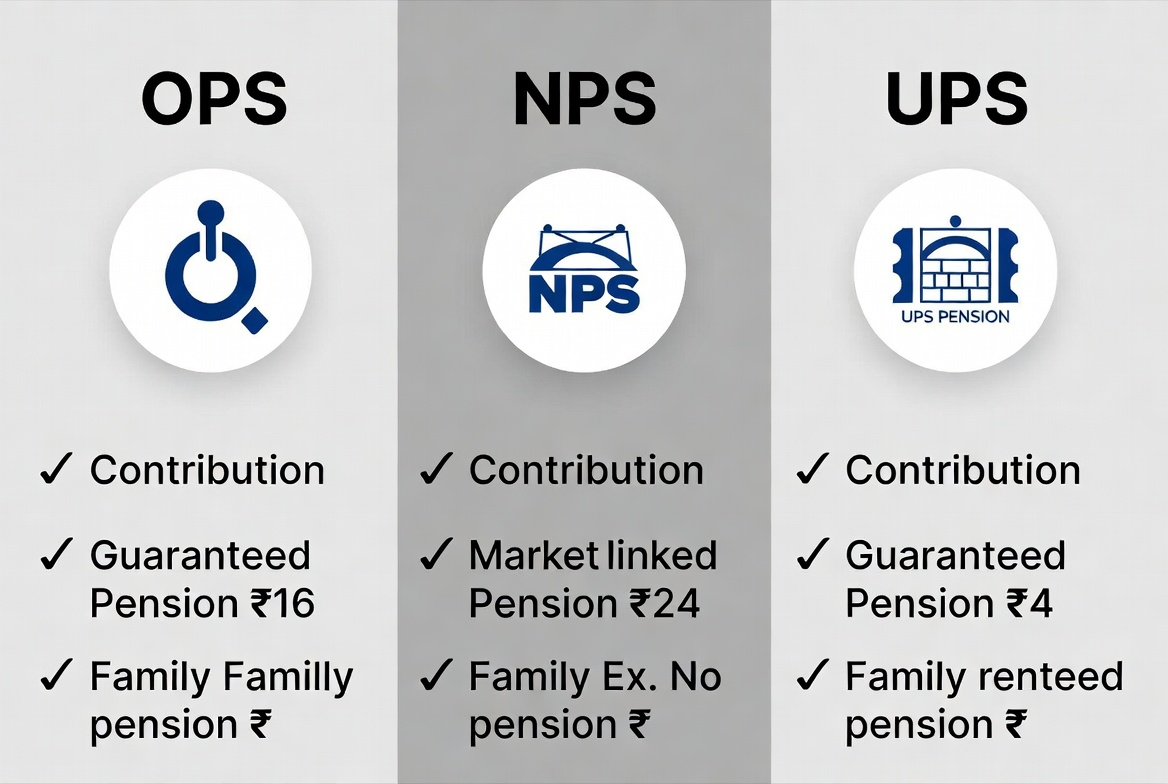
8. Master Comparison Table: OPS vs NPS vs UPS
| Feature / Parameter | Old Pension Scheme (OPS) | National Pension System (NPS) | Unified Pension Scheme (UPS) |
|---|---|---|---|
| Scheme Architecture | Defined Benefit (Unfunded) | Defined Contribution (Market) | Hybrid (Assured Defined Benefit + Funded) |
| Employee Contribution | Zero (0%) | 10% of (Basic + DA) | 10% of (Basic + DA) |
| Government Contribution | 100% Budgetary Payout | 14% of (Basic + DA) | 18.5% (~10% Individual + 8.5% Guarantee Pool) |
| Assured Monthly Pension | 50% of Last Basic Pay | No Guarantee (Annuity Market) | 50% of Last 12 Months Avg Basic Pay (≥25y) |
| Minimum Pension Floor | ₹9,000 / month | Zero / Market-dependent | ₹10,000 / month (≥10y service) |
| Family Pension Protection | Yes (30% to 50%) | Annuity dependent | 60% of employee's pension payout to spouse |
| Inflation Adjustment | Full Dearness Relief (DR) | No Inflation Relief on Annuity | Dearness Relief (DR) linked to AICPI-IW |
9. Implementation Status & State Notifications till July 2026
As per MoS Finance Pankaj Chaudhary's statement in July 2026, over 25,756 retired central employees became eligible for retro-active UPS benefits. Nine states (Uttarakhand, Odisha, Goa, Tripura, Haryana, Chhattisgarh, Arunachal Pradesh, Assam, and Maharashtra) have notified UPS for state employees.
10. Link with 8th Central Pay Commission
Constituted in November 2025, the Terms of Reference of the 8th Central Pay Commission include examining pension provisions under NPS and UPS to suggest further refinements before its recommendations take effect in 2026–2027.
11. Must Remember Points for Quick Revision

Quick Revision Summary:
- Effective Date: 1 April 2025 (Cabinet approval 24 Aug 2024).
- Committee: TV Somanathan Committee.
- Assured Pension: 50% of last 12 months average basic pay (≥25 years service).
- Minimum Pension: ₹10,000 per month (≥10 years service).
- Family Pension: 60% of employee's pension payout to spouse.
- Contributions: Employee 10% + Government ~18.5% (10% + 8.5% Guarantee Pool).
- Inflation Indexation: Dearness Relief (DR) linked to AICPI-IW.
12. Conclusion & Action Steps for Aspirants
UPS balances employee demand for guaranteed retirement income with long-term macroeconomic stability. Memorize the 50% formula, 18.5% government contribution, and the comparison matrix for your exams!
Frequently Asked Questions (Exam FAQ)
What is the assured pension percentage under the Unified Pension Scheme (UPS)?
UPS guarantees an assured pension equal to 50% of the average basic pay drawn in the last 12 months before retirement for employees with at least 25 years of qualifying service.
What is the government contribution rate under UPS compared to NPS?
Government contribution increases from 14% under NPS to 18.5% under UPS. Employee contribution remains unchanged at 10% of basic pay + DA.
What is the minimum pension guaranteed under UPS for shorter service?
UPS guarantees a minimum pension of Rs 10,000 per month for employees retiring after at least 10 years of service.
Sources: Ministry of Finance, Press Information Bureau (PIB) Releases, PFRDA.
NEEDS DOUBLE-CHECK: none
Master Service Rules & Economy Policy on RRBCONTENTS
Practice PYQs, read current affairs notes, and explore job exam guides.
Solve Service Rules PYQs → Explore Govt Jobs →Join our official Telegram channel: @rrbcontents