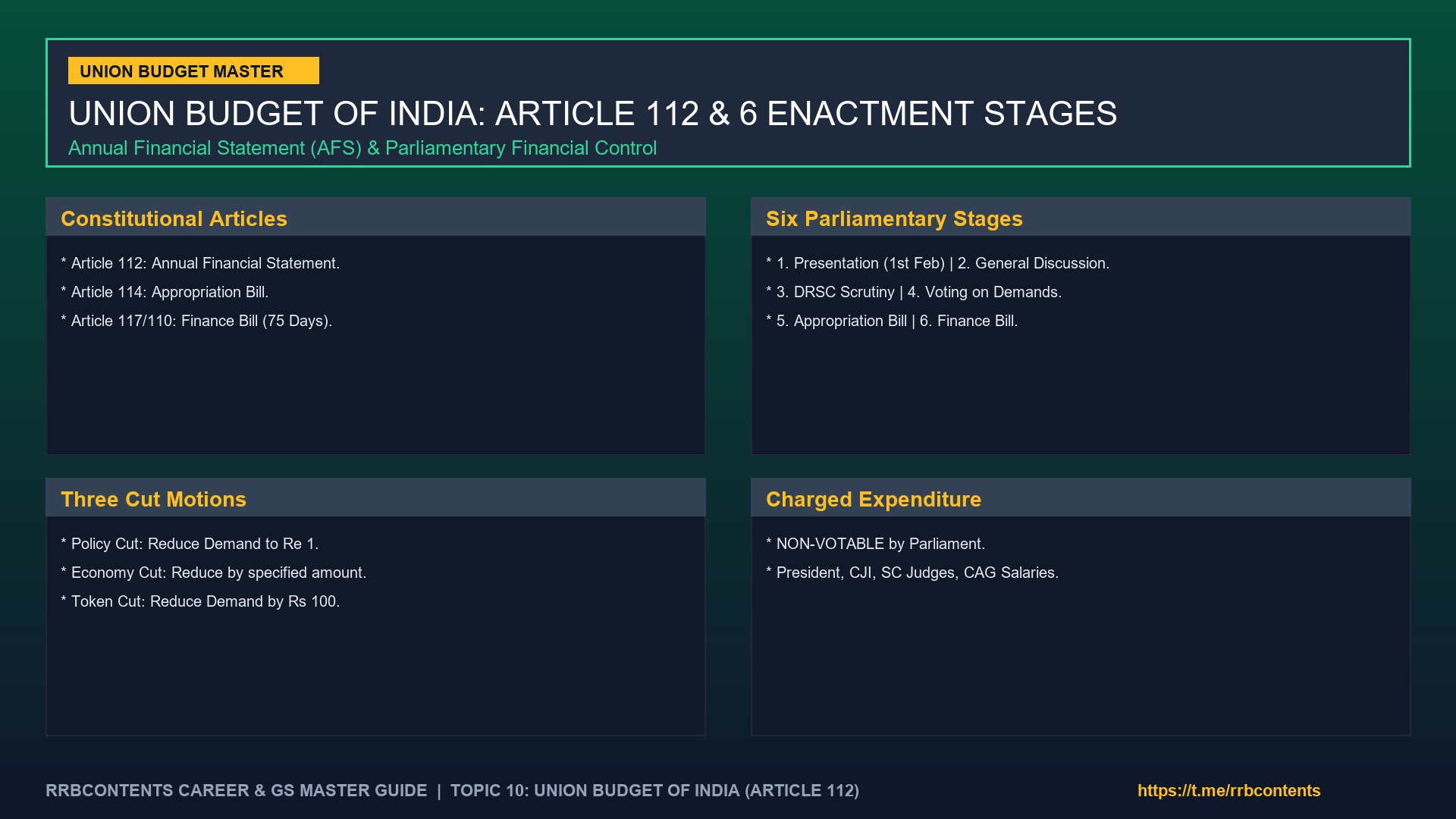
UNION BUDGET OF INDIA: CONSTITUTIONAL PROVISIONS (ARTICLE 112), 6 STAGES OF ENACTMENT, TYPES OF BUDGETS & DEFICIT CONCEPTS (COMPLETE GUIDANCE FOR COMPETITIVE EXAMS)
Chapter 1
INTRODUCTION
The Union Budget of India is the Annual Financial Statement of the Central Government, detailing its estimated receipts and expenditures for the upcoming financial year (1st April to 31st March). It is the primary instrument of national fiscal policy, socio-economic planning, public resource allocation, and macroeconomic management.
It is a crucial constitutional fact for competitive exam aspirants that the word "Budget" does NOT appear anywhere in the Constitution of India! Instead, Article 112 of the Constitution refers to it as the "Annual Financial Statement" (AFS).
The presentation and passage of the Union Budget in Parliament is not merely an accounting exercise; it is a supreme constitutional obligation enforcing legislative control over the public purse. Under Article 265 ("No tax shall be levied or collected except by authority of law") and Article 266 ("No money shall be withdrawn from the Consolidated Fund of India except under appropriation made by law"), the Executive cannot spend a single rupee or collect a single rupee in taxes without the express approval of Parliament.
For aspirants preparing for competitive examinations such as UPSC Civil Services (GS Paper II & GS Paper III Economics), State Public Service Commissions (BPSC, UPPSC, MPPSC, RAS), SSC CGL, and Banking Exams, mastering Article 112, the 6 stages of budget enactment, cut motion rules, deficit formulas (Fiscal, Revenue, Primary, Effective Revenue Deficits), and historical budget reforms is essential.
This comprehensive master career guide provides an exhaustive breakdown of the Union Budget of India. We cover every legal detail—from Articles 112 to 117 and 6 parliamentary stages to 4 deficit types, 3 cut motions, historical committee milestones, 12 exam-focused FAQs, and essential revision tools.
---
Chapter 2
CONSTITUTIONAL ARTICLES GOVERNING THE BUDGETARY PROCESS
CONSTITUTIONAL ARTICLES GOVERNING THE BUDGETARY PROCESS - Illustrative Reference
Constitutional Pillars of the Indian Budget System
├── Article 112: Annual Financial Statement (AFS) - Statement of estimated receipts & expenditures
├── Article 113: Procedure in Parliament with respect to estimates (Demands for Grants & Voting)
├── Article 114: Appropriation Bill (Mandatory law authorizing withdrawal from Consolidated Fund)
├── Article 115: Supplementary, Additional, or Excess Grants (Post-budget funding mechanisms)
├── Article 116: Vote on Account, Votes of Credit & Exceptional Grants (Interim funding allocations)
├── Article 117: Special provisions as to Financial Bills (Tax proposals & legal enactments)
├── Article 265: Taxes not to be imposed save by authority of law
├── Article 266: Consolidated Fund of India (CFI) & Public Account of India
└── Article 267: Contingency Fund of India (Held by Finance Secretary on behalf of President)
| Article | Constitutional Provision / Legal Requirement | Practical Impact on Budget |
|---|---|---|
| Article 112 | Annual Financial Statement (AFS): President causes to be laid before both Houses estimated receipts & expenditures. | Primary budget document presented by Finance Minister. |
| Article 113(1) | Estimates relating to expenditure charged upon Consolidated Fund shall NOT be submitted to vote of Parliament. | Charged Expenditure (e.g. CJI/Judges salaries, CAG) is non-votable. |
| Article 113(2) | Estimates relating to other expenditure submitted in form of Demands for Grants to Lok Sabha. | Votable Expenditure voted exclusively in Lok Sabha. |
| Article 113(3) | No Demand for Grant shall be made except on recommendation of the President. | Executive privilege over spending proposals. |
| Article 114 | Appropriation Bill: Mandatory law authorizing withdrawal of funds from Consolidated Fund of India. | Converts voted demands into legal authority to spend. |
| Article 116(1)(a) | Vote on Account: Grant made in advance by Lok Sabha for part of financial year pending budget passage. | Ensures government machinery operates before full budget approval. |
| Article 265 | No Tax Without Authority of Law: Imposition of taxes requires express legislative enactment. | Gives legal necessity to pass the Finance Bill. |
---
Chapter 3
CHARGED EXPENDITURE VS VOTABLE EXPENDITURE
Total Budget Expenditure
├── 1. Charged Expenditure upon Consolidated Fund of India (NON-VOTABLE)
└── 2. Votable Expenditure (Submitted as Demands for Grants)
Chapter 4
1. Emoluments and allowances of the President of India and office expenses.
Chapter 5
2. Salaries, allowances, and pensions of the Speaker and Deputy Speaker of Lok Sabha, and Chairman and Deputy Chairman of Rajya Sabha.
Chapter 6
3. Salaries, allowances, and pensions of the Chief Justice of India and Judges of the Supreme Court.
Chapter 7
4. Pensions of Judges of High Courts.
---
Chapter 8
THE SIX STAGES OF BUDGET ENACTMENT IN PARLIAMENT
Six Parliamentary Stages of Budget Enactment
├── Stage 1: Presentation of the Budget (By Finance Minister on 1st February)
├── Stage 2: General Discussion (3-4 Days discussion in both Houses; NO voting)
├── Stage 3: Scrutiny by Departmental Standing Committees (3-4 Weeks recess; 24 DRSCs audit Demands)
├── Stage 4: Voting on Demands for Grants (Exclusive to Lok Sabha; Cut Motions & Guillotine)
├── Stage 5: Passage of Appropriation Bill (Article 114 - Legal authority to withdraw funds)
└── Stage 6: Passage of Finance Bill (Article 117/110 - Legal authority to levy taxes)
---
- The Halwa Ceremony: Conducted annually in the basement of North Block about 10 days before Budget presentation. The Finance Minister stirs traditional Indian sweet 'Halwa' and distributes it to Ministry officials.
- Secrecy & Lock-In Period: Following the Halwa Ceremony, over 100 officials from the Budget Division (Department of Economic Affairs), printing staff, and translation experts enter a mandatory lock-in period inside North Block. They remain completely isolated without mobile phones or internet access until the Finance Minister presents the budget in Lok Sabha, preventing any market leaks.
- Date of Presentation: Presented on 1st February (advanced from last working day of February in 2017).
- Budget Speech: The Finance Minister presents the budget in Lok Sabha with a speech divided into two parts:
- Part A: Macroeconomic overview, economic performance, and sector allocations.
- Part B: Direct and indirect tax proposals, tax slab changes, and customs duty revisions.
- Simultaneous Laying: Simultaneously laid on the table of Rajya Sabha. No discussion takes place on the day of presentation.
---
- Takes place a few days after presentation in both Houses for 3 to 4 days.
- Parliament discusses the budget as a whole and the fiscal policies of the Government.
- Crucial Rule: NO voting takes place at this stage, and no cut motions can be moved. The Finance Minister delivers a reply at the end of the discussion.
---
- After general discussion, both Houses of Parliament are adjourned for a 3 to 4 week recess.
- During this recess, the 24 Departmentally Related Standing Committees (DRSCs) examine the detailed Demands for Grants of their respective ministries.
- DRSCs prepare detailed reports and submit them to both Lok Sabha and Rajya Sabha without recommending tax increases.
---
- Exclusive Lok Sabha Jurisdiction: Voting on Demands for Grants is the exclusive privilege of Lok Sabha! (Rajya Sabha has NO power to vote on demands).
- Demands Format: Each ministry submits a separate Demand for Grant. Usually 100+ demands are presented.
- Moving Cut Motions: Members of Lok Sabha can move Cut Motions to reduce the amount of a demand.
- Token Cut Motion: Reduces demand by Rs 100 to express a specific grievance within the Government's responsibility.
- Economy Cut Motion: Reduces demand by a specified amount to enforce expenditure economy.
- Policy Cut Motion: Reduces demand to Re 1, expressing fundamental policy disapproval. Passing any Cut Motion in Lok Sabha signifies a loss of parliamentary majority, forcing the Government to resign!
The 3 Cut Motions in Lok Sabha
├── 1. Policy Cut Motion: "That the amount of the demand be reduced to Re 1."
├── 2. Economy Cut Motion: "That the amount of the demand be reduced by a specified amount."
└── 3. Token Cut Motion: "That the amount of the demand be reduced by Rs 100."
On the final day allotted for voting on Demands for Grants, the Speaker of Lok Sabha puts all remaining undiscussed demands to vote simultaneously, whether discussed by members or not. This parliamentary procedure is called the "Guillotine."
---
- After voting on Demands for Grants is completed, the Appropriation Bill is introduced in Lok Sabha.
- Under Article 114, no money can be withdrawn from the Consolidated Fund of India without the passage of the Appropriation Bill.
- Once passed by Lok Sabha and certified as a Money Bill by the Speaker, it is transmitted to Rajya Sabha (which must return it within 14 days). Once signed by the President, it becomes the Appropriation Act.
---
- The Finance Bill contains the legal tax proposals, tariff modifications, and amendments to the Income Tax Act, GST Act, and Customs Act to give effect to the financial proposals of the Government.
- Introduced as a Money Bill under Article 110.
- Under the Provisional Collection of Taxes Act, 1931, the Finance Bill MUST be passed by Parliament and assented to by the President within 75 days of its introduction!
---
1. Supplementary Grant (Article 115(1)(a)): Granted when the original amount authorized by the Appropriation Act for a particular service is found to be insufficient for that year.
2. Additional Grant (Article 115(1)(a)): Granted when a need arises during the current financial year for additional expenditure upon some new service not contemplated in the original budget.
3. Excess Grant (Article 115(1)(b)): Granted when money has been spent on any service during a financial year in excess of the amount granted for that service. Must be audited by the Public Accounts Committee (PAC) before being submitted to Lok Sabha for voting.
4. Exceptional Grant (Article 116(1)(c)): Granted for a special purpose which forms no part of the current service of any financial year.
5. Vote of Credit (Article 116(1)(b)): Granted for meeting an unexpected demand upon national resources when on account of magnitude or indefinite character of service, demand cannot be stated with details (referred to as a "Blank Cheque" given to Executive).
- Presentation Date: Presented in Parliament exactly one day prior to the Union Budget (31st January).
- Core Functions:
Chapter 9
1. Reviews economic developments in the Indian economy over the past financial year.
Chapter 10
2. Provides GDP growth forecasts for the upcoming fiscal year.
Chapter 11
3. Analyzes sectoral trends in Agriculture, Industry, Services, Forex Reserves, and Inflation.
- Volume Structure: Features analytical chapters on key policy themes (e.g., green transition, digital public infrastructure, labor market trends).
Chapter 12
TYPES OF BUDGETS & HISTORICAL BUDGET REFORMS
- Conventional / Line-Item Budget: Traditional accounting budget focusing on itemized spending inputs without tracking outcomes.
- Performance Budget: Focuses on achievements, physical targets, and operational results rather than mere financial inputs. (Introduced in India in 1968 based on 1st ARC recommendations).
- Zero-Based Budget (ZBB): Every financial year starts from a "zero base." Every line item of expenditure must be re-justified from scratch, rather than taking past expenditure as a given base. (First introduced in India in 1987 in Ministry of Science & Tech).
- Gender Budget: A budget disclosure statement assessing the impact of government budget allocations on women empowerment and gender equity. (Introduced in India in 2005-06).
- Outcome Budget: Measures physical outputs and tangible socio-economic outcomes of financial allocations across all ministries.
2017 Structural Budget Reforms
├── 1. Merger of Railway Budget with Union Budget (Ended 92-year-old separate Railway Budget)
├── 2. Advancing Budget Presentation Date to 1st February
└── 3. Abolition of Plan vs Non-Plan Expenditure Distinction
---
- N.K. Singh FRBM Review Committee (2017) Recommendations:
Chapter 13
1. Central Government Fiscal Deficit target of 3.0% of GDP.
Chapter 14
2. General Government Debt-to-GDP ceiling of 60% (40% for Centre, 20% for States).
3. Escape Clause (Section 4(2)): Allows deviation of up to 0.5% of GDP from fiscal deficit targets under exceptional circumstances (national security, war, severe agricultural collapse, pandemic).
- High Multiplier Effect: Capital expenditure (Capex - on highways, railways, ports) has a crowding-in multiplier effect of 2.45 to 3.14, creating long-term productive economic assets.
- Low Multiplier Effect: Revenue expenditure (consumption subsidies, administrative operational costs) has a low multiplier effect of 0.90 to 0.99.
Chapter 15
COMPREHENSIVE BREAKDOWN OF BUDGET DEFICIT CONCEPTS
Budget Accounts Classification
├── Revenue Account (Recurrent / Non-creation of assets)
│   ├── Revenue Receipts (Tax Revenues + Non-Tax Revenues like Dividends, Fees)
│   └── Revenue Expenditure (Salaries, Pensions, Subsidies, Interest Payments)
└── Capital Account (Creation of assets / Reduction of liabilities)
    ├── Capital Receipts (Debt Receipts: Borrowings; Non-Debt Receipts: Disinvestment, Recovery of Loans)
    └── Capital Expenditure (Construction of Roads, Railways, Defence Equipment, Loan Grants)
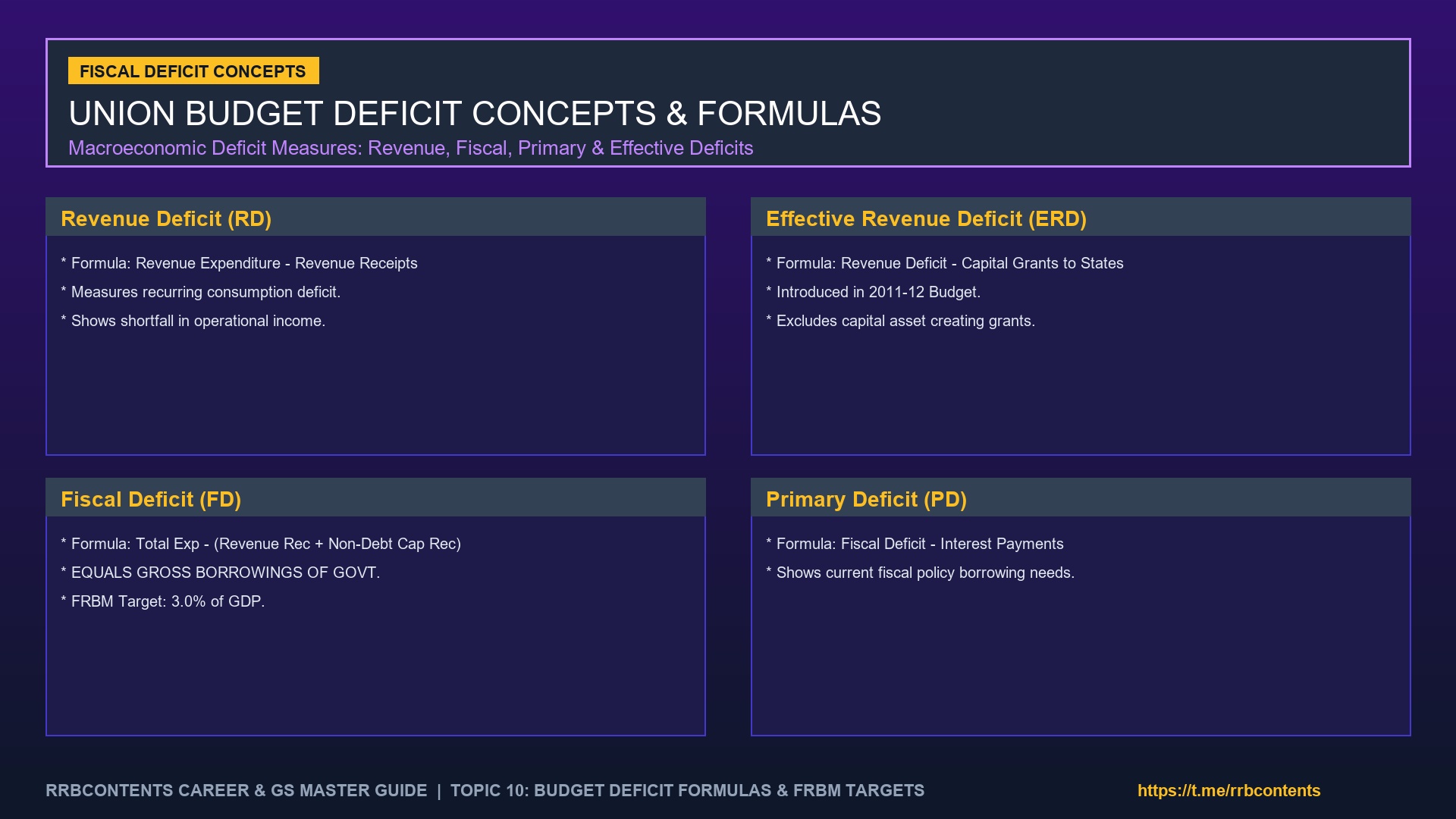
| Deficit Concept | Mathematical Formula & Definition | Macroeconomic Significance |
|---|---|---|
| Revenue Deficit (RD) | $$ ext{Revenue Expenditure} - ext{Revenue Receipts}$$ | Indicates government consumption spending exceeds recurring revenue earnings. |
| Effective Revenue Deficit (ERD) | $$ ext{Revenue Deficit} - ext{Grants for Capital Assets Creation}$$ | Introduced in 2011-12; excludes capital-creating grants paid to States. |
| Fiscal Deficit (FD) | $$ ext{Total Expenditure} - ( ext{Revenue Receipts} + ext{Non-Debt Capital Receipts})$$ | Gross borrowings of Government of India. Reflects total financial gap. |
| Primary Deficit (PD) | $$ ext{Fiscal Deficit} - ext{Interest Payments}$$ | Indicates net borrowing needs arising from current fiscal policy, excluding past debt interest. |
---
- Public Account of India (Article 266(2)): Holds money received by government acting as a banker or trustee (e.g. Provident Funds / EPF, Small Savings deposits, Judicial deposits).
- No Executive Authorization Needed: Payments out of the Public Account do NOT require parliamentary appropriation under Article 114, as they are executive disbursements.
Chapter 16
IMPORTANCE FOR COMPETITIVE EXAMS & QUICK REVISION
1. Article Key: Art 112 (Annual Financial Statement), Art 113 (Demands for Grants), Art 114 (Appropriation Bill), Art 116 (Vote on Account), Art 265 (No Tax without Law), Art 266 (Consolidated Fund), Art 267 (Contingency Fund).
2. Cut Motions: Policy Cut (Reduce to Re 1), Economy Cut (Reduce by specified sum), Token Cut (Reduce by Rs 100).
3. Budget Dates & Reforms: Presented 1st Feb. Railway Budget merged 2017 (Bibek Debroy Rec - ended 1924 Acworth separation). Finance Bill passed within 75 days.
4. Votable vs Charged: Charged expenditure (President, CJI, SC Judges, CAG) discussed but NOT voted upon.
---
Chapter 17
FREQUENTLY ASKED QUESTIONS (FAQS)
Chapter 18
# Q1: Is the word "Budget" explicitly mentioned in the Indian Constitution?
Answer: No. The word "Budget" is not mentioned in the Constitution; Article 112 uses the term "Annual Financial Statement" (AFS).
Chapter 19
# Q2: What is the difference between an Appropriation Bill and a Finance Bill?
Answer: An Appropriation Bill (Article 114) authorizes the withdrawal of money from the Consolidated Fund of India for expenditure. A Finance Bill (Article 117/110) contains legal tax proposals and modifications to levy taxes.
Chapter 20
# Q3: Which committee recommended the merger of the Railway Budget with the Union Budget in 2017?
Answer: The Bibek Debroy Committee recommended the merger in 2017, ending the 92-year-old separate Railway Budget system established under the Acworth Committee in 1924.
Answer: No. Voting on Demands for Grants is the exclusive privilege of Lok Sabha. Rajya Sabha can only discuss the budget.
Answer: The "Guillotine" is a parliamentary procedure where the Lok Sabha Speaker puts all remaining undiscussed Demands for Grants to vote simultaneously on the last allotted voting day.
Answer: A Policy Cut Motion moves "that the amount of the demand be reduced to Re 1", representing complete disapproval of the policy underlying the demand.
Chapter 21
# Q7: What is the difference between Revenue Deficit and Fiscal Deficit?
Answer: Revenue Deficit is the excess of revenue expenditure over revenue receipts. Fiscal Deficit is the total expenditure minus total non-debt receipts, representing the total borrowings of the Government.
Answer: Primary Deficit is calculated as $$ ext{Fiscal Deficit} - ext{Interest Payments}$$, showing borrowing requirements for current year operations without past debt obligations.
Answer: A Vote on Account is an advance grant passed by Lok Sabha to cover essential government expenditure for a short period (usually 2 months) pending the full passage of the budget.
Answer: Zero-Based Budgeting is a budgeting method where every line item of expenditure must be re-justified from a zero base every year, rather than adjusting past expenditure.
Chapter 22
# Q11: Who holds the Contingency Fund of India under Article 267?
Answer: The Contingency Fund of India is held by the Finance Secretary on behalf of the President of India to meet urgent unforeseen expenditures pending parliamentary approval.
Chapter 23
# Q12: Within how many days must the Finance Bill be passed by Parliament?
Answer: Under the Provisional Collection of Taxes Act, 1931, the Finance Bill MUST be passed by Parliament and assented to by the President within 75 days of its introduction.
---
Answer: A Supplementary Grant is presented to Parliament when the original amount voted in the budget for a specific service falls short during the financial year.
Answer: A Vote of Credit is an advance grant given by Lok Sabha for meeting unexpected national emergencies (like war) when detailed expenditure estimates cannot be stated, acting as a "blank cheque" to the Executive.
Answer: A strict 10-day secrecy period following the Halwa Ceremony where budget printing and Ministry of Finance staff remain locked inside North Block without outside communication to prevent leaks.
Chapter 24
# Q16: What is the Economic Survey of India and who prepares it?
Answer: The Economic Survey is the annual economic report of the Government of India prepared under the guidance of the Chief Economic Advisor (CEA) and presented one day before the Budget.
Chapter 25
# Q17: What is the 'Escape Clause' under the FRBM Act, 2003?
Answer: The Escape Clause allows the Central Government to deviate up to 0.5% of GDP from its target fiscal deficit during national emergencies, war, or economic shocks.
- Joint Secretary (Budget): Heads the Budget Division in the Department of Economic Affairs (Ministry of Finance), consolidating revenue estimates from CBDT, CBIC, and expenditure demands from all 55+ ministries.
- Paperless Digital Budget: Since 2021, the Union Budget is presented in a completely paperless format, accessible to MPs and the public via the official Union Budget Mobile App.
Chapter 26
TYPES OF DEFICITS IN UNION BUDGET
Understanding the 4 primary types of budgetary deficits for competitive exams:
1. Fiscal Deficit: $ ext{Total Expenditure} - ext{Total Receipts excluding Borrowings}$. Measures total government borrowing requirement.
2. Revenue Deficit: $ ext{Revenue Expenditure} - ext{Revenue Receipts}$. Indicates government spending on day-to-day administration beyond earnings.
3. Effective Revenue Deficit (ERD): $ ext{Revenue Deficit} - ext{Grants for Creation of Capital Assets}$. Introduced in Budget 2011-12.
4. Primary Deficit: $ ext{Fiscal Deficit} - ext{Interest Payments}$. Reflects current year fiscal stance excluding past debt interest burden.
---
Chapter 27
# Charged Expenditure vs Expenditure Made from Consolidated Fund:
- Charged Expenditure: Includes salaries/allowances of President, CJI, CAG, UPSC Chairman. Voted by Parliament? NO. Parliament can discuss it, but it is NOT submitted to vote.
- Expenditure Made from Consolidated Fund: Submitted to Lok Sabha in the form of Demands for Grants and requires voting.
---
Chapter 28
# Vote on Account vs Interim Budget:
- Vote on Account: Purely a grant for advance spending passed by Lok Sabha to cover routine government expenditure for 2 months (1/6th of total estimate) while budget approval is pending. Cannot change tax rates.
- Interim Budget: Presented in an election year; includes full estimates of expenditure and receipts, financial performance, and policy announcements for the transition period.
---
Chapter 29
# Tax Expenditure / Revenue Foregone:
- Concept introduced in Union Budget to measure tax revenue foregone due to tax incentives, exemptions, deductions, and reduced tax rates given to corporate and individual taxpayers.
- Published annually as a separate statement alongside the Union Budget documents to enforce transparency in tax policy concessions.
---
Chapter 30
CONCLUSION
The Union Budget of India is the supreme economic blueprint of the nation, blending constitutional accountability under Articles 112 to 117 with fiscal discipline and developmental goals. Through the 6 stages of parliamentary enactment, Lok Sabha voting on Demands for Grants, Appropriation and Finance Acts, and FRBM deficit targets, the budget ensures that executive spending remains transparent and democratically authorized.
For competitive exam aspirants, mastering Article 112, budget enactment stages, cut motion types, deficit formulas, and financial bills guarantees complete preparation for scoring top marks in Indian Economy and Polity.
👉 Official Career Portal: [https://rrbcontents.com](https://rrbcontents.com)
👉 Official Telegram Channel: [Join RRBCONTENTS Telegram (@rrbcontents)](https://t.me/rrbcontents)
---
Chapter 31
ADDITIONAL EXAM INSIGHTS & CASE STUDIES
---
Chapter 32
# A. Revenue Receipts vs Capital Receipts — Detailed Classification
Revenue Receipts (Do NOT create liability or reduce government assets):
- Tax Revenue:
- Direct Taxes: Personal Income Tax, Corporate Tax (Corporation Tax), Capital Gains Tax, Securities Transaction Tax (STT)
- Indirect Taxes: GST (CGST + IGST Centre's share), Basic Customs Duty, Union Excise Duty (on petroleum products outside GST)
- Non-Tax Revenue:
- Interest receipts on loans given to states, PSUs, and foreign governments
- Dividends and profits from PSUs (ONGC, HPCL, NTPC, etc.)
- RBI surplus transfer (e.g., RBI transferred Rs 2.11 lakh crore to Government in FY2024 — a record)
- Fees, fines, penalties (passport, visa, judicial fines)
- Grants-in-aid received from foreign governments/multilateral agencies
- Receipts from civil services (railways, postal, etc.)
Capital Receipts (CAN create liability OR reduce government assets):
- Debt-creating Capital Receipts:
- Market borrowings (dated securities, Treasury Bills, Cash Management Bills)
- External commercial borrowings (from World Bank, ADB, bilateral)
- Small savings collections (PPF, NSC, Kisan Vikas Patra)
- Provident Fund collections
- Securities against small savings
- Non-debt Capital Receipts:
- Disinvestment / Privatisation (selling government equity in PSUs — reduces government asset)
- Recovery of loans given to states and PSUs
Exam Rule: Revenue Deficit = Revenue Expenditure − Revenue Receipts. If Revenue Receipts exceed Revenue Expenditure, there is a Revenue Surplus. India has historically run a Revenue Deficit, meaning government borrows even for day-to-day expenses — a structural weakness.
---
Chapter 33
# B. Key Fiscal Deficit Trends in India — Data Table
| Year | Fiscal Deficit (% of GDP) | Significant Context |
|---|---|---|
| 2018–19 | 3.4% | Near-FRBM target; stable fiscal environment |
| 2019–20 | 4.6% | Slowing economy; corporate tax cut stimulus |
| 2020–21 | 9.2% | COVID-19 pandemic — highest in decades; massive expenditure surge |
| 2021–22 | 6.7% | Economic recovery; capex push began |
| 2022–23 | 6.4% | Gradual consolidation; global commodity price pressures |
| 2023–24 | 5.8% | Revised estimates; revenue buoyancy from GST and direct taxes |
| 2024–25 (Target) | 5.1% | Union Budget 2024–25 target; path to FRBM compliance |
| FRBM Medium-Term Target | 4.5% | Targeted by 2025–26 as per fiscal consolidation roadmap |
Exam Perspective: India's fiscal deficit widened dramatically in 2020–21 due to pandemic-related spending and revenue collapse. The Government invoked the FRBM Escape Clause to justify deviation from 3% target. Subsequent years show gradual consolidation — a standard pattern tested in mains and prelims.
---
Chapter 34
# C. FRBM Act (2003) — Provisions, Amendments & NK Singh Committee
Key Provisions of FRBM Act, 2003:
- The Central Government must present 3 fiscal statements along with the Annual Budget:
1. Medium Term Fiscal Policy Statement — 3-year rolling targets for fiscal and revenue deficits
2. Fiscal Policy Strategy Statement — rationale for variations from targets; economic outlook
3. Macroeconomic Framework Statement — GDP growth assumptions, tax buoyancy projections
- Original targets: Reduce fiscal deficit to 3% of GDP and eliminate revenue deficit
- Escape Clause (Section 4(3)): FRBM targets can be relaxed during: (a) national security emergencies or natural calamities, (b) national recession, (c) structural reforms with unanticipated fiscal implications
N.K. Singh Committee on FRBM Review (2017):
- Set up by Finance Ministry to review the FRBM framework post-GST implementation
- Recommended creating an independent Fiscal Council (independent watchdog — not yet implemented)
- Proposed shift from deficit targeting to debt targeting — debt-to-GDP of 60% total (Centre: 40% + States: 20%) as the anchor
- Recommended making the Escape Clause more explicit with graduated triggers
- Report proposed fiscal deficit targets of 3% by 2020 with a permanent Escape Clause band of ±0.5%
---
Chapter 35
# D. GST — Constitutional Architecture & Budget Impact
- Launch Date: 1 July 2017 (implemented at the stroke of midnight — midnight session of Parliament)
- Constitutional Amendment: 101st Constitutional Amendment Act, 2016 — inserted Articles 246A, 269A, 279A
- Replaced: Central Excise Duty, Service Tax, Additional Customs Duty (CVD/SAD), State VAT, Entry Tax, Octroi, Purchase Tax, Luxury Tax, Entertainment Tax
- GST Rate Structure:
- 0% (exempt): Essential food items, books, educational services, health services
- 5%: Edible oils, sugar, spices, tea, coffee, domestic LPG
- 12%: Processed food, mobile phones, computers
- 18%: Most services, electronics, capital goods
- 28%: Luxury goods (cars, tobacco, aerated beverages)
- Compensation Cess: Levied over and above 28% on demerit/luxury goods (cigarettes, luxury cars, pan masala) to fund state compensation
- Constitutional Dual GST Structure:
- CGST (Central GST): On intra-state supplies; goes entirely to Central Government
- SGST (State GST): On intra-state supplies; goes entirely to respective State Government
- IGST (Integrated GST): On inter-state supplies; collected by Centre and then apportioned between Centre and destination State as per Article 269A
- GST Council — Key Facts:
- Established under Article 279A of the Constitution (inserted by 101st Amendment)
- Chair: Union Finance Minister (ex-officio)
- Members: Finance Ministers of all States/UTs + MoS Finance (Centre)
- Voting: Centre has 1/3rd voting power; States together have 2/3rd voting power
- Decisions: Require 3/4th majority of weighted votes — ensuring no single party can dominate
- In Union of India vs Mohit Minerals (2022), the Supreme Court held that GST Council recommendations are not binding on Parliament or State legislatures — they are only persuasive, preserving fiscal federalism
- State Compensation: States were guaranteed 14% annual revenue growth for the first 5 years (2017–2022). Compensation paid from Compensation Cess Fund. During COVID (2020–21), Centre borrowed on behalf of states when cess collections fell short. The compensation period ended on 30 June 2022.
---
Chapter 36
IMAGE GENERATION PROMPTS
`A high-resolution, realistic digital photograph of the Parliament House of India (Sansad Bhavan) illuminated at dusk during the Union Budget session, with the Indian National Flag fluttering atop the dome. Professional architecture photography, 8k resolution, photorealistic quality.`
`A detailed realistic photo illustration of the Union Finance Minister presenting the Budget speech inside the Lok Sabha chamber, surrounded by Members of Parliament and official red budget leather briefing portfolios. High detail, warm interior lighting, photorealistic.`
Prepare with RRBCONTENTS
Free mock tests, previous year papers, and daily current affairs for UPSC, SSC & Railway exams.
Start Free Mock Tests →Continue Reading
Explore More Articles
Knowledge Hub
More Blog Articles
In-depth articles on Polity, Economy, Environment and Current Affairs.
Study Material
Exam Study Notes
Subject-wise notes and digests for Railway, SSC, Banking and State PSC exams.
Current Affairs
Daily Current Affairs & GK
Daily updates and static GK bank with active-recall quizzes.