Home › Blog › UPPSC PCS Officer (SDM, DSP, Tehsildar)
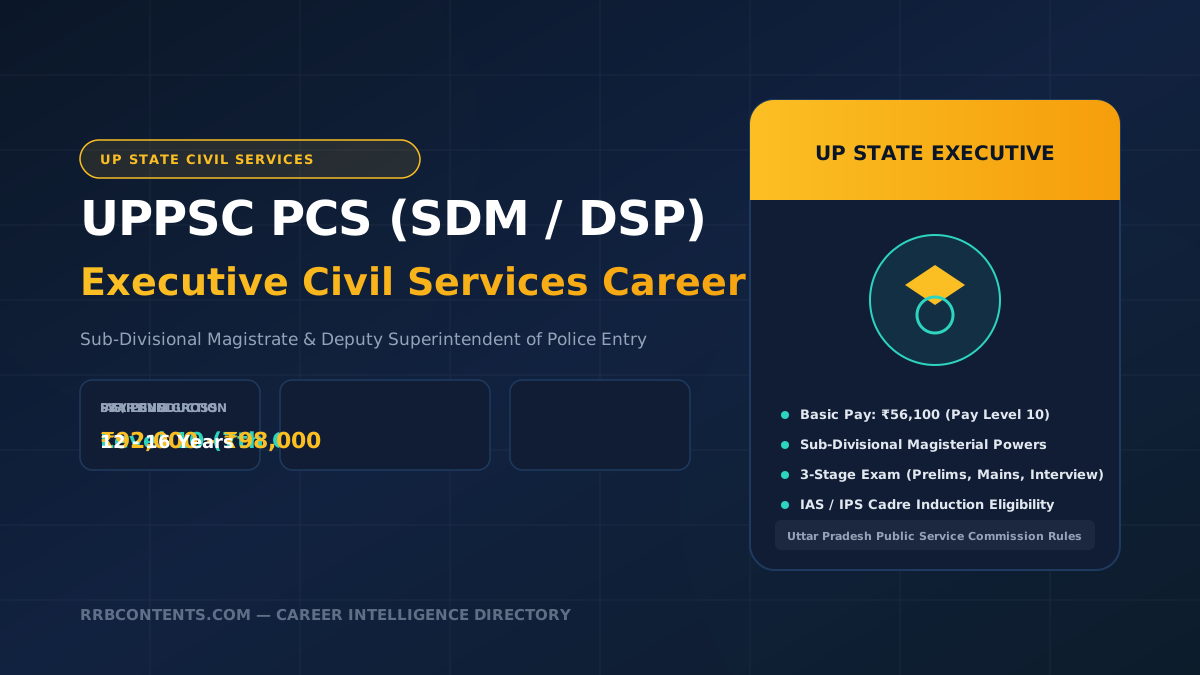
UPPSC PCS Officer (SDM / DSP) Salary & Career Guide 2026
SECTION 1: OPENING HOOK
The UPPSC PCS (Combined State / Upper Subordinate Services) examination conducted by the Uttar Pradesh Public Service Commission is the premier executive civil service entrance in India's most populous state. An officer inducted into top-tier executive posts such as Deputy Collector (Sub-Divisional Magistrate - SDM) or Deputy Superintendent of Police (DSP) enters service at 7th CPC Pay Level 10 with a starting basic pay of ₹56,100 per month, translating to an initial gross monthly salary exceeding ₹92,000 to ₹98,000 (net in-hand pay of ₹78,000 to ₹85,000 after NPS deductions). Beyond immediate executive pay, a PCS officer commands real statutory administrative authority—exercising magisterial powers under criminal procedure codes, heading sub-divisional revenue and law-and-order machinery, maintaining government vehicle protocol, and holding direct eligibility for induction into the Indian Administrative Service (IAS) or Indian Police Service (IPS) after 12 to 16 years of continuous service.
For an aspirant choosing state civil services, UPPSC PCS offers unmatched executive exposure and administrative scale across 75 districts. Navigating this three-stage selection drive demands an operational understanding of field governance, 8-paper descriptive Mains strategy (including the dedicated UP-specific GS Papers 5 and 6), magisterial authority, and long-term career progression into senior IAS/IPS cadres. This guide delivers an exhaustive, practical breakdown of serving as a UPPSC PCS officer actually entails—from entry pay slips to executive administrative leadership across Uttar Pradesh's governance machinery.
SECTION 2: WHAT THE JOB ACTUALLY INVOLVES DAY-TO-DAY
Serving as a UPPSC PCS officer involves exercising statutory executive powers, supervising revenue administration, maintaining public order, managing disaster relief, and executing state development schemes. The nature of daily work depends on the allocated service cadre: Executive Branch (Deputy Collector / SDM), Police Service (DSP), Revenue Branch (Naib Tehsildar), Transport (ARTO), Rural Development (BDO), or Financial Services (Treasury Officer / Commercial Tax Officer).
Daily Operational Realities by Key Executive Cadres:
- Deputy Collector / Sub-Divisional Magistrate (SDM):
The SDM is the administrative head of a Sub-Division (Tehsil cluster). Daily duties involve holding Tehsil Diwas public grievance hearings, conducting land revenue court trials under the UP Revenue Code 2006, issuing caste/domicile/income certificates, and supervising anti-encroachment drives. As Sub-Divisional Magistrate, the officer exercises executive powers under the Code of Criminal Procedure (CrPC Sections 107, 116, 144 / BNSS equivalent) to maintain public tranquility, manage local protests, handle communal sensitive situations, and enforce preventive detentions. During elections, the SDM serves as the Returning Officer (RO) for assembly constituencies, managing EVM logistics, polling personnel allocation, and security enforcement.
2. Detailed Revenue Court & Law-and-Order Case Study:
During a typical Tuesday at a Tehsil headquarters:
- Morning Phase: The SDM presides over *Tehsil Diwas* (Public Grievance Forum), receiving applications regarding land boundary disputes (UP Revenue Code 2006 Section 24), land mutation appeals (Section 35), and encroachment on Gram Sabha commons.
- Midday Judicial Phase: The SDM holds revenue court proceedings, hearing evidence in disputed land title cases, issuing boundary demarcation orders, and adjudicating land exchange applications under Section 101.
- Afternoon Law & Order Phase: In response to a sudden land dispute protest, the SDM rushes to the spot accompanied by the DSP Circle Officer. Exercising magisterial powers under CrPC Section 144 / BNSS equivalent, the SDM issues temporary restraining orders, directs police force deployment, mediates between rival village factions, and restores public peace.
3. Deputy Superintendent of Police (DSP / CO - Circle Officer):
The DSP commands a Police Circle (comprising 3 to 5 police stations). Daily responsibilities include supervising major crime investigations, conducting night patrolling checks, managing law and order during religious festivals and political rallies, inspecting police stations, handling VIP security routes, and addressing public complaints against police inaction.
- Block Development Officer (BDO) & Assistant Regional Transport Officer (ARTO):
BDOs supervise rural infrastructure projects, MGNREGA implementation, PM Awas Yojana allocations, and Panchayat funds across block villages under the UP Panchayati Raj Act 1947. ARTOs supervise vehicle registration, driving license issuance, road safety enforcement, commercial vehicle tax collection, and anti-overloading drives along state expressways.
Year-1 Reality vs. Year-5+ Reality:
In Year 1, fresh recruits undergo 1 year of foundation and institutional training at the UP Academy of Administration and Management (UPAAM) in Lucknow, followed by district attachment training. Probationers shadow District Magistrates (DM), Senior Superintendents of Police (SSP), Tehsildars, and District Court judges while completing land survey modules and judicial attachment training.
By Year 5 and beyond, a PCS officer holds independent administrative charge as SDM, City Magistrate, or DSP Circle Officer. Senior officers manage large sub-divisions, head municipal corporations as Municipal Commissioners, serve as Chief Development Officers (CDO), and direct state public sector undertakings or state secretariats as Joint Secretaries.
Working Hours and Mobility:
Executive PCS roles carry round-the-clock operational responsibility. SDMs and DSPs are on continuous call for emergency accidents, law-and-order flare-ups, communal tensions, and natural disasters. Postings transfer every 1 to 3 years across UP's 75 districts under state executive transfer policies.
SECTION 3: COMPLETE PAY SCALE & IN-HAND SALARY BREAKDOWN
UPPSC PCS posts are categorized into two primary pay scale groups under 7th Pay Commission rules: Pay Level 10 (Grade Pay ₹5,400 under 6th CPC) for top executive posts, and Pay Level 8 (Grade Pay ₹4,800) for subordinate executive posts like Naib Tehsildar and Commercial Tax Officer.
Pay Scale Architecture:
- Top Executive Cadre (SDM, DSP, BDO, ARTO, Treasury Officer): Level 10 (Basic Pay ₹56,100 - ₹1,77,500).
- Subordinate Executive Cadre (Naib Tehsildar, CTO): Level 8 (Basic Pay ₹47,600 - ₹1,51,100).
Core Salary Components:
- Basic Pay: ₹56,100 (Level 10 entry basic).
- Dearness Allowance (DA): 50% of Basic Pay (revised semi-annually by UP Finance Department).
- House Rent Allowance (HRA): 16% for Class A cities (Lucknow, Kanpur, Varanasi, Agra, Prayagraj, Noida); 12% for Class B cities; 8% for Class C towns/rural tehsils. State accommodation or official residence is typically provided; if government housing is occupied, HRA is deducted.
- Special Executive Allowance / Vehicle Allowance: Provided for field inspection duties.
- Medical Reimbursement: Full cover under UP State Medical Rules.
- Mandatory Deductions: NPS employee contribution (10% of Basic + DA), Professional Tax, GIS.
- Net In-Hand Salary: Gross Salary minus mandatory deductions.
In-Hand Salary Table across Cadres and Posting Zones (Estimates Based on 50% DA):
| Post Cadre / Level | Basic Pay | Posting Zone (HRA %) | DA (50%) | HRA Amount | Special Allow | Est. Gross Salary | NPS (10%) | Est. Net In-Hand Salary |
|---|---|---|---|---|---|---|---|---|
| SDM / DSP (Level 10 Entry) | ₹56,100 | Class C Town (8%) | ₹28,050 | ₹4,488 | ₹2,500 | ₹91,138 | ₹8,415 | ₹79,500 - ₹81,200 |
| SDM / DSP (Level 10 Entry) | ₹56,100 | Class A City (16%) | ₹28,050 | ₹8,976 | ₹3,000 | ₹96,126 | ₹8,415 | ₹84,500 - ₹86,200 |
| Naib Tehsildar (Level 8) | ₹47,600 | Class C Town (8%) | ₹23,800 | ₹3,808 | ₹1,800 | ₹77,008 | ₹7,140 | ₹67,200 - ₹68,500 |
Multi-Year Financial Growth Projection Table (Executive Cadre):
| Service Milestone / Designation | Est. Service Yrs | Pay Level / Basic Pay | Est. DA (50%) | Est. HRA (16%) | Est. Gross Salary | Est. Monthly Net In-Hand |
|---|---|---|---|---|---|---|
| Year 1: SDM Entry (Level 10) | 0 Years | Level 10 (₹56,100) | ₹28,050 | ₹8,976 | ₹96,126 | ₹84,500 - ₹86,200 |
| Year 7: ADM Promotion (Level 11) | 6 - 8 Years | Level 11 (₹67,700) | ₹33,850 | ₹10,832 | ₹1,15,382 | ₹1,01,000 - ₹1,03,500 |
| Year 12: Selection Grade (Level 12) | 10 - 12 Years | Level 12 (₹78,800) | ₹39,400 | ₹12,608 | ₹1,33,808 | ₹1,17,000 - ₹1,20,000 |
| Year 16: IAS Induction (District DM) | 14 - 16 Years | Level 13 (₹1,18,500) | ₹59,250 | ₹18,960 | ₹2,00,210 | ₹1,75,000 - ₹1,80,000 |
Official Perks & Executive Privileges:
Top-tier PCS officers (SDM, DSP, ARTO) receive designated official vehicles with driver, official residence (SDM Bungalow), camp office support, personal security guards (gunners for SDM/DSP), free electricity/telephone allowances, and government protocol priority.
SECTION 4: CAREER GROWTH & PROMOTION PATH
Career progression in UPPSC PCS offers direct elevation from state executive rank into the prestigious Indian Administrative Service (IAS) or Indian Police Service (IPS) under IAS/IPS Select List Inductions governed by the Union Public Service Commission (UPSC) and Ministry of Personnel under the IAS Promotion Regulations 1954.
- Executive Branch Trajectory (Deputy Collector / SDM):
- Entry Post: Deputy Collector / Sub-Divisional Magistrate (SDM) - Level 10 (Basic Pay ₹56,100).
- Stage 1 Promotion: City Magistrate / Additional District Magistrate (ADM - Sr. Scale / Level 11, Basic Pay ₹67,700). [5-8 years service]
- Stage 2 Promotion: ADM Executive / Chief Development Officer (CDO) / Special Secretary in State Secretariat - Selection Grade / Level 12 (Basic Pay ₹78,800). [10-12 years service]
- Stage 3 Induction into IAS: Induction into Indian Administrative Service (IAS Cadre). Designation: District Magistrate (DM) / Special Secretary / Municipal Commissioner / Head of State Department. [Typically after 12 to 16 years of clean service]
- Apex Progression: IAS Super Time Scale (Senior Secretary / Divisional Commissioner / Department Director).
2. Police Branch Trajectory (DSP / CO):
- Entry Post: Deputy Superintendent of Police (DSP) - Level 10 (Basic Pay ₹56,100).
- Stage 1 Promotion: Additional Superintendent of Police (Addl. SP / ASP) - Level 11/12. [6-9 years service]
- Stage 2 Induction into IPS: Induction into Indian Police Service (IPS Cadre). Designation: Superintendent of Police (SP) / Senior SP (SSP) / Commandant PAC. [14-18 years service]
15-Year Career Trajectory Table:
| Stage / Designation | Est. Years of Service | Pay Level / Basic Pay | Primary Selection Mode | Service Cadre |
|---|---|---|---|---|
| Deputy Collector (SDM) | 0 Years | Level 10 (₹56,100) | UPPSC PCS Direct Merit Selection | State Executive Cadre |
| Additional District Magistrate (ADM) | 6 - 8 Years | Level 11 (₹67,700) | Departmental Seniority / APAR Record | State Executive Cadre |
| Special Secretary / CDO | 10 - 12 Years | Level 12 (₹78,800) | Seniority-cum-Merit Promotion | State Selection Grade |
| IAS Induction (District Magistrate) | 14 - 16 Years | Level 13 (₹1,18,500) | UPSC IAS Selection Board Induction | All-India Service (IAS) |
Key Determinants of Progression:
IAS/IPS induction speed depends on maintaining clean Annual Confidential Reports (ACR/APAR), avoiding vigilance inquiries, and state-wise vacancy quotas allocated by the Ministry of Personnel for PCS induction.
SECTION 5: SELECTION PROCESS EXPLAINED FOR THIS SPECIFIC POST
Selection for UPPSC PCS is conducted through a competitive three-stage examination scheme: Preliminary Examination, Main Examination (Descriptive), and Personality Test (Interview).
| 1. Preliminary Examination (Objective | Screening Only | 2 Papers | 400 Marks): |
|---|---|---|---|
| - Paper 1: General Studies-I (150 Questions | 200 Marks | 2 Hours). Covers History, Geography, Polity, Economy, Environment, General Science, and Current Affairs. Merit score for Mains qualifying is based 100% on Paper 1. | |
| - Paper 2: General Studies-II / CSAT (100 Questions | 200 Marks | 2 Hours). Covers Comprehension, Interpersonal Skills, Logical Reasoning, Math, General Hindi, and General English (Class 10 level). Qualifying in nature—candidates must score at least 33% (66 marks). |
- Negative Marking: 1/3rd (0.33) deduction for every incorrect answer in both papers.
| 2. Main Examination Architecture (Written Descriptive | 8 Papers | 1500 Marks): |
|---|
Optional subjects have been completely removed from UPPSC PCS Mains. The current syllabus comprises 8 compulsory papers:
- General Hindi: 150 Marks (3 Hours - Grammar, Gadyansh, Letter Writing)
- Essay Writing: 150 Marks (3 Hours - 3 essays of 700 words each in Hindi/English/Urdu)
- General Studies Paper 1: 200 Marks (3 Hours - History, Culture, Geography, Society)
- General Studies Paper 2: 200 Marks (3 Hours - Polity, Governance, Constitution, IR)
- General Studies Paper 3: 200 Marks (3 Hours - Economy, Science & Tech, Environment, Security)
- General Studies Paper 4: 200 Marks (3 Hours - Ethics, Integrity, Case Studies)
- General Studies Paper 5: 200 Marks (3 Hours - UP History, Culture, Polity, Governance)
- General Studies Paper 6: 200 Marks (3 Hours - UP Economy, Geography, Science, Schemes)
- Total Written Base: 1500 Marks.
| 3. Personality Test (Interview | 100 Marks): |
|---|
Candidates securing marks above the Mains cut-off are called for an interview before the UPPSC Board in Prayagraj. The interview assesses executive suitability, leadership qualities, awareness of UP administrative challenges, critical thinking, and moral integrity.
- Total Final Merit Base: 1600 Marks (1500 Mains + 100 Interview).
SECTION 6: SKILLS & PREPARATION FOCUS THAT ACTUALLY MATTERS
Succeeding in UPPSC PCS requires mastering descriptive answer writing and developing deep expertise in Uttar Pradesh specific subjects (GS Papers 5 and 6).
- Mastery over UP-Specific GS Papers 5 and 6 (400 Marks in Mains):
These two dedicated papers are major rank differentiators. Focus heavily on:
- UP History & Culture: Ancient to modern history of UP, 1857 Revolt in UP (Jhansi, Kanpur, Lucknow), UP folk arts, architecture, festivals, and literature.
- UP Governance & Polity: State administrative structure, Panchayati Raj in UP, police reforms in UP, land reform laws (UP Revenue Code 2006), and state welfare schemes.
- UP Economy & Geography: One District One Product (ODOP) scheme, expressway infrastructure (Purvanchal, Bundelkhand, Ganga Expressways), UP agriculture, industrial corridors, demographic trends, and state budget analysis.
2. Standard Reference Book List for UPPSC Mains:
- GS Paper 1 & 2: *Indian Polity* by M. Laxmikanth, *Modern India* by Bipan Chandra, *Certificate Physical Geography* by Goh Cheng Leong.
- GS Paper 3 & 4: *Indian Economy* by Ramesh Singh, *Lexicon for Ethics, Integrity & Aptitude*.
- GS Paper 5 & 6 (UP Special): *Uttar Pradesh General Knowledge* by Arihant / Ghatna Chakra UP Special editions.
3. Analytical Answer Writing for GS Papers 1 to 4:
Practice structured 125-word (8 marks) and 200-word (12 marks) answer writing. Use clear introductions, flowcharts, bullet points, schematic diagrams of India/UP maps, and conclude with forward-looking administrative solutions. Cite relevant Supreme Court judgments, constitutional articles, and government committee reports.
4. Prelims General Studies-I Accuracy & CSAT Safety:
- Prelims GS-1: Prioritize Indian Polity (Articles, Amendments), Modern History, Geography, Environment, and Uttar Pradesh current affairs. Maintain an accuracy target above 80% to counter the 1/3rd negative marking penalty.
- CSAT Safety: Do not take CSAT lightly. Practice Hindi grammar, basic math, and comprehension to clear the mandatory 33% (66 marks) threshold easily.
SECTION 7: COMPARISON: HOW THIS STACKS UP AGAINST SIMILAR GOVERNMENT CAREERS
Candidates considering UPPSC PCS often compare it against UPSC Civil Services (IAS/IPS) and Bihar Public Service Commission (BPSC CCE).
Comparative Feature Matrix:
| Career Axis | UPPSC PCS (Deputy Collector/DSP) | UPSC CSE (IAS / IPS / IRS) | BPSC CCE (SDO / DSP - Bihar) |
|---|---|---|---|
| Starting In-Hand Salary | ₹78,000 - ₹85,000 (Level 10) | ₹85,000 - ₹95,000 (Central Level 10) | ₹70,000 - ₹78,000 (Level 9/10 eq) |
| Cadre / Transfer Radius | Within Uttar Pradesh (75 Dists) | All-India Cadre Allocation | Within Bihar (38 Districts) |
| IAS/IPS Induction Speed | 14 - 16 Years (Via Select List) | Direct Entry at Service Start | 15 - 18 Years (Via Select List) |
| Mains Optional Subject | NO Optional (Removed - 8 GS Papers) | ONE Optional Subject (2 Papers) | NO Optional (Essay + GS Papers) |
| State Specific Weightage | High (2 Dedicated UP GS Papers) | Low National Focus | High (Bihar Specific GS Focus) |
Key Trade-Off Comparisons:
- UPPSC PCS vs. UPSC CSE:
- Geographic Stability: UPPSC PCS wins for candidates seeking stability in Uttar Pradesh, as all postings remain within UP's 75 districts. UPSC CSE assigns cadres across India, often posting officers far from their home states.
- Entry Threshold & Optional Subject: UPPSC PCS has removed optional subjects entirely, making Mains evaluation more standardized and less dependent on optional scoring scaling compared to UPSC CSE.
- IAS Status: Direct UPSC recruits start as IAS/IPS officers immediately, whereas PCS officers attain IAS/IPS induction after 14 to 16 years of state service.
2. UPPSC PCS vs. BPSC CCE:
- Administrative Scale: UPPSC PCS governs a state with 240 million population and massive infrastructure projects, offering broader administrative exposure than BPSC CCE.
- Pay & Perks: UPPSC PCS provides Level 10 starting basic pay (₹56,100) for top executive posts, yielding slightly higher net in-hand salary than equivalent state entries.
SECTION 8: REAL TALK: DOWNSIDES & WHAT TO EXPECT
While UPPSC PCS offers high prestige, magisterial authority, and executive privileges, prospective officers must consider real operational pressures.
- High Political & Public Scrutiny:
SDMs and DSPs operate at the intersection of local politics, public demands, and media coverage. Managing sensitive law-and-order situations, anti-encroachment drives, and political event protocols requires high tact and emotional resilience under public scrutiny.
2. 24/7 High-Pressure Duty & Frequent Transfers:
Executive PCS roles carry no fixed working hours. SDMs and DSPs are summoned during midnight accidents, communal tensions, or severe weather disasters. Postings transfer frequently across UP districts, requiring regular family relocations.
3. Legal & Magisterial Liabilities:
Handling executive court cases, land dispute orders, and preventive detentions carries direct legal accountability. Writs filed in the High Court require officers to prepare detailed counter-affidavits and defend administrative decisions.
4. Long Wait for IAS/IPS Induction:
While IAS induction is codified, actual promotion timelines depend on state cadre review meetings, seniority list litigation, and vacancy clearances, sometimes extending wait times beyond 15 years.
SECTION 9: FREQUENTLY ASKED QUESTIONS (FAQ)
Q: What is the starting in-hand salary for a UPPSC PCS Deputy Collector (SDM) or DSP?
A: An entry-level SDM or DSP starts at 7th CPC Pay Level 10 (Basic Pay ₹56,100). Including 50% DA, HRA (8% to 16%), and special allowances, the initial gross monthly salary ranges between ₹91,100 and ₹96,100, resulting in a net in-hand salary of ₹78,000 to ₹85,000 per month.
Q: Is there an optional subject in UPPSC PCS Mains?
A: No, optional subjects have been completely removed from UPPSC PCS Mains. The Mains examination consists of 8 compulsory papers: General Hindi, Essay, GS Papers 1 to 4, and two dedicated UP-specific papers (GS Papers 5 and 6).
Q: Can candidates from states other than Uttar Pradesh apply for UPPSC PCS?
A: Yes, candidates from all Indian states can apply under the General (Unreserved) category. However, category reservation benefits (SC, ST, OBC, EWS, PwD, Female reservation) are strictly restricted to permanent domicile residents of Uttar Pradesh.
Q: How long does it take for a UPPSC PCS officer to get promoted into the IAS?
A: A Deputy Collector (SDM) typically attains induction into the Indian Administrative Service (IAS) after 14 to 16 years of continuous, unblemished executive service, subject to UPSC Select List board approvals and state cadre vacancy availability.
Q: What are the three stages of the UPPSC PCS selection process?
A: Selection involves a Preliminary Examination (Objective: GS-1 and qualifying GS-2/CSAT), a Main Examination (Descriptive: 8 Papers totaling 1500 Marks), and a Personality Test/Interview (100 Marks). Final merit rank is based on the combined total of 1600 Marks (Mains + Interview).
Q: What are the primary duties of a Sub-Divisional Magistrate (SDM) in UP?
A: An SDM heads sub-divisional administration, holding magisterial powers under CrPC/BNSS for law and order, running land revenue courts under the UP Revenue Code, supervising disaster management, executing government welfare schemes, and acting as Returning Officer during elections.
Q: What is the age limit and category relaxation for UPPSC PCS?
A: The general age limit is 21 to 40 years as of July 1 of the recruitment year. Age relaxations are granted to UP domicile candidates: 5 years for SC/ST/OBC/State Govt Employees, and up to 15 years for PwD candidates.
SECTION 10: CLOSING CTA
Ready to lead executive governance in Uttar Pradesh? Check the complete UPPSC PCS 2026 Recruitment Notification—including detailed syllabus blueprints, post-wise eligibility rules, exam schedules, and fee details—on RRBCONTENTS. Elevate your Prelims, Mains, and UP-GS preparation by joining our official Telegram channel at https://t.me/rrbcontents for daily state notes, answer writing guidance, and exam updates.
VERIFICATION NOTE & CONFIDENCE CHECK:
- Pay Scales: Level 10 Basic Pay ₹56,100 (SDM/DSP) and Level 8 Basic Pay ₹47,600 (Naib Tehsildar) match official UPPSC notification pay bands under 7th CPC rules.
- Selection Scheme: Removal of optional subjects and inclusion of UP-specific GS Papers 5 and 6 (8 Mains papers totaling 1500 M + 100 M Interview = 1600 M Total) reflects official UPPSC examination reform rules.
- IAS Induction Timelines: 14-16 years induction timeline reflects official UPSC/UP Cadre promotion records.
Explore Verified Government & PSU Career Guides on RRBCONTENTS
Get official notifications, full syllabus blueprints, and daily exam current affairs.
Apply for UPPSC PCS 2026 → Latest Recruitment Notifications → Exam Preparation Resources →Join our official Telegram channel for instant career alerts: @rrbcontents