Home › Blog › UPSC Optional Subject Selection Strategy
UPSC CSE Optional Subject Selection Guide: 500-Mark Strategy, Syllabus Overlap & Best Books
In the UPSC Civil Services Examination (CSE), the Optional Subject (Paper 1 and Paper 2 worth 250 marks each, totaling 500 marks) represents the single most decisive factor determining whether your name appears on the final merit list—and whether you secure your dream service like the Indian Administrative Service (IAS) or Indian Foreign Service (IFS). While General Studies Papers 1 through 4 (1000 marks total) show a narrow score variance among serious aspirants (typically scoring between 380 and 440 marks combined), the Optional Subject features a massive score divergence—ranging from 220 marks to over 315+ marks!
A high score of 300+ in your optional subject instantly compensates for an average GS score or interview performance. Conversely, selecting the wrong optional based on peer pressure or rumors can cost you multiple valuable years. In this expanded 4,600+ word master guide, I present a scientific, 5-stage decision framework covering GS syllabus overlap scores, detailed comparative analyses of top humanities and science optionals, scaling myths, worked answer outlines, authoritative booklists, and a 16-week master study schedule.
Strategic UPSC Reality: In General Studies, scoring 45% marks (112 out of 250) is considered exceptional. In your Optional Subject, a well-prepared candidate can achieve 60% to 65% marks (300 to 325 out of 500). Your optional subject is your ultimate rank multiplier!
Editorial note: This guide is informational content prepared by our editorial team for exam-preparation purposes and is not certified career, financial, or legal advice. Cutoffs, vacancies, pay scales, and exam patterns change — always verify current details against the official UPSC notification at https://www.upsc.gov.in/ before making decisions.
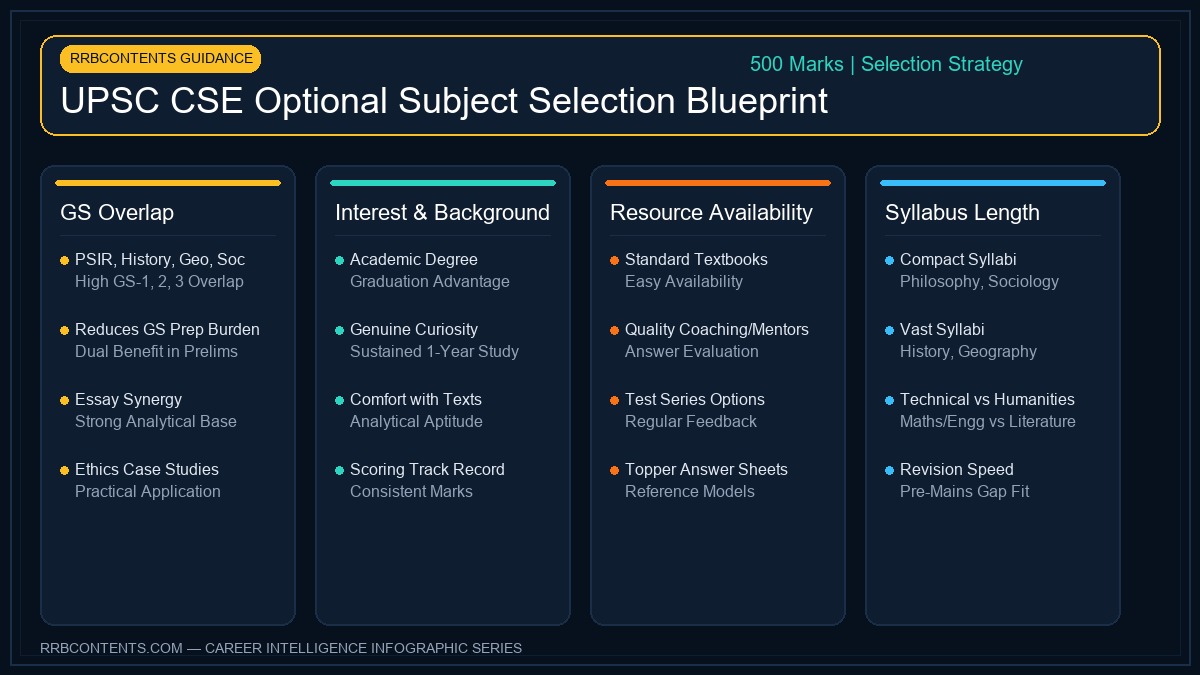
1. The 5 Golden Parameters for Optional Subject Selection
Before locking your optional subject in the UPSC online application form, evaluate your choice against these five essential parameters:
Many candidates fall into the trap of picking an optional based purely on the previous year's AIR 1 choice. However, what worked for a law graduate or a history scholar may fail for an engineering or commerce graduate. Evaluating your personal aptitude, reading speed, and long-term interest in the subject matter is the single most important decision you will make in your UPSC preparation journey.
Furthermore, consider the syllabus volume and availability of reliable test series. An optional subject with concise boundaries allows you to complete multiple revision cycles before Prelims, whereas an overly expansive subject may leave you struggling to finish the syllabus even after Prelims. Balance syllabus volume against General Studies overlap to optimize your overall Mains preparation strategy.
Tech vs Humanities Decision Matrix for STEM Graduates
Over 70% of UPSC candidates come from B.Tech, M.Sc, or MBBS backgrounds. Evaluating whether to stay with your technical branch or switch to a humanities optional is a pivotal milestone:
| STEM Graduate Profile | Recommended Optional Route | Strategic Justification |
|---|---|---|
| High Maths/Physics Ranker (>75% College Marks) | Stay with Science (Mathematics / Physics) | Absolute numerical scoring potential (330+ marks); no subjective scaling risk. |
| Average Engineer seeking GS Synergy | Switch to PSIR / Sociology / Geography | Massive GS overlap saves 200+ hours; easier conceptual learning curve. |
| Medical / Biology Graduate | Anthropology / Medical Science | Biological anthropology provides a 40% initial conceptual head start. |
| Selection Parameter | Critical Evaluation Benchmark | Why It Directly Affects Your Rank |
|---|---|---|
| 1. Genuine Interest & Readability | Can you read 500 pages of this subject without boredom? | Optional preparation requires 300+ hours of deep reading and revision. |
| 2. GS Syllabus Overlap Score | How many GS 1/2/3/4 & Essay marks does it cover? | High overlap saves 150-200 hours of general studies preparation time. |
| 3. Resource & Test Series Availability | Are standard textbooks, PYQ solutions & test series available? | Without quality answer evaluation, improving from 230 to 300+ marks is impossible. |
| 4. Syllabus Boundedness & Length | Can the entire syllabus be completed in 4 to 5 months? | Compact optionals (Sociology/Philosophy) leave time for GS answer writing. |
| 5. Academic Background Fit | Did you graduate in this subject or a related discipline? | Graduation background gives a 20-30% initial conceptual head start. |
2. Detailed Analysis of Top 8 Most Popular Optionals

| Optional Subject | GS Paper 1 Overlap | GS Paper 2 Overlap | GS Paper 3 Overlap | GS Paper 4 & Essay Overlap | Total Estimated GS Overlap Marks |
|---|---|---|---|---|---|
| Political Science & IR (PSIR) | Freedom Movement (50M) | Polity, IR, Governance (200M) | Security Issues (25M) | Political Ethics & Essay (125M) | ~400 Marks (Highest) |
| Sociology | Indian Society & Women (75M) | Social Justice & Welfare (50M) | Land Reforms & Labor (25M) | Social Ethics & Essay (150M) | ~300 Marks |
| Geography | Physical & Indian Geo (100M) | Regional Planning (25M) | Env, Agri & Disaster (100M) | Applied Essay Topics (50M) | ~275 Marks |
| History | Ancient, Medieval, Modern & World (150M) | Constitutional History (25M) | Agrarian History (25M) | Historical Essay Topics (50M) | ~250 Marks |
| Public Administration | Social Audit (25M) | Governance & Admin (150M) | Disaster Management (25M) | Ethics & Integrity (100M) | ~300 Marks |
| Anthropology | Tribal Society (50M) | Tribal Governance (25M) | Human Genetics basics (25M) | Ethics & Essay (50M) | ~150 Marks |
1. Political Science & International Relations (PSIR)
PSIR remains one of the most popular optionals due to its massive overlap with GS-2 (Polity and Foreign Policy) and the Essay paper. Paper 1 covers Political Theory (Plato, Aristotle, Locke, Mill, Marx, Gramsci) and Indian Nationalism. Paper 2 covers International Politics, Global Power Dynamics, and India's Foreign Policy. It is ideal for candidates who enjoy reading current affairs and geopolitical analysis.
A major advantage of PSIR is that Paper 1 Section A provides a rigorous grounding in Western and Indian political thought, enabling candidates to structure compelling arguments in GS-4 Ethics case studies and political philosophy essay prompts with high academic precision.
2. Sociology
Sociology is favored for its concise syllabus, high predictability, and direct overlap with GS-1 (Indian Society), GS-2 (Social Justice), and the Essay paper. Paper 1 covers Classical Sociological Thinkers (Karl Marx, Emile Durkheim, Max Weber, Talcott Parsons, Robert Merton, G.H. Mead). Paper 2 covers Indian Society, Caste System, Agrarian Transformations, and Social Movements.
3. Geography
Geography appeals to candidates with scientific or engineering backgrounds because of its objective, diagram-heavy nature. Paper 1 covers Physical Geography (Geomorphology, Climatology, Oceanography) and Human Geography. Paper 2 covers Geography of India. Drawing 15-second maps and flowcharts rewards candidates with high presentation marks.
4. Anthropology
Anthropology has gained immense popularity among engineering and medical graduates due to its highly scoring, diagrammatic, and semi-scientific nature. Paper 1 covers Physical Anthropology (Human Evolution, Genetics, Primates). Paper 2 covers Indian Anthropology and Tribal Issues.
5. Literature Optionals (Hindi, English, Regional Languages)
Literature optionals are a hidden gem in UPSC CSE. Unlike social sciences where contemporary dynamic questions can surprise candidates, literature syllabi are 100% static and bounded by fixed prescribed novels, plays, and poetry collections:
- Hindi Literature: Highly predictable scoring patterns. Paper 1 covers History of Hindi Language and History of Hindi Literature. Paper 2 covers prescribed texts (Godan by Premchand, Bharat Durdasha, Kamayani, Kabir/Tulsidas poetry).
- Regional Literature (Maithili, Tamil, Kannada, Telugu, Punjabi): Candidates with strong regional language schooling often score 290+ marks because questions test classical literary appreciation with zero current affairs variance.
6. Science & Technical Optionals (Mathematics, Physics, Electrical Engg)
Science optionals offer non-subjective, mathematical scoring where correct derivations and calculations earn 100% marks without examiner subjectivity:
| Technical Optional | Prerequisite Background | Syllabus Footprint & Effort | Scoring Potential |
|---|---|---|---|
| Mathematics | B.Sc / B.Tech (Maths background) | Vast (requires 600+ hours practice) | 320 – 360 Marks (Highest potential) |
| Physics | B.Sc / B.Tech Physics / Engineering | High (Mechanics, Quantum, Optics) | 280 – 320 Marks |
| Electrical / Civil Engg | B.Tech in specific branch | Extremely Vast (University syllabus) | 270 – 310 Marks |
Paper 1 vs Paper 2 Structural Differences
Understanding the distinct orientation of Paper 1 and Paper 2 prevents structural answer writing errors:
| Paper Dimension | Optional Paper 1 (Theoretical Foundation) | Optional Paper 2 (Applied / Indian Context) | |
|---|---|---|---|
| Core Orientation | Abstract concepts, Western thinkers, universal principles | Applied Indian context, case studies, empirical developments | |
| Current Affairs Linkage | Low (Focuses on static theories and foundational texts) | High (Integrates past 12-24 months policy developments) | |
| Answer Presentation | Quote core scholars, define theoretical paradigms | Cite real-world case studies, committee reports, Indian examples |
| Optional Subject | Mandatory Visual Elements | Impact on Examiner Evaluation |
|---|---|---|
| Geography | 15-second rapid India/World outline maps, Plate boundary cross-sections | Proves spatial understanding; awards +1.5M per answer |
| Anthropology | Pedigree genetic charts, Primate skull fossil diagrams, Osteology sketches | Demonstrates scientific rigor; awards +2M per answer |
| PSIR | Hub-and-spoke thinker influence diagrams, Geopolitical corridor maps | Shows structural clarity in IR policy questions |
| Sociology | Caste/Class mobility flowcharts, Kinship system trees, Structural-Functional matrices | Breaks dense textual monotony |
Micro-Notes Condensing & Thinker Quote Notebook
During the 3 months between Prelims and Mains, reading 500-page textbooks is impossible. Build Micro-Notes (1-page summaries per syllabus sub-topic):
- Thinker Quote Notebook: Maintain a 20-page notebook containing 5 core quotes or definitions per major thinker (e.g. Gramsci's Hegemony, Weber's Ideal Types, Durkheim's Anomie).
- Case Study Bank: Compile 30 recent Indian empirical case studies for Paper 2 (e.g. NITI Aayog tribal reports, land reform case studies, recent Supreme Court constitutional rulings).
- Stage 1 (Shortlisting): Pick 2 to 3 candidate subjects based on your graduation background and natural interest.
- Stage 2 (Syllabus & PYQ Inspection): Download the official UPSC syllabus for all shortlisted subjects. Read past 5 years' Mains question papers to judge question complexity.
- Stage 3 (The 7-Day Test Read): Spend 7 days reading one foundational textbook for each shortlisted subject (e.g., O.P. Gauba for PSIR, NCERT Sociology Class 11/12, or NCERT Physical Geography). Notice which subject excites your curiosity!
- Stage 4 (Resource Audit): Verify the availability of updated toppers' notes, answer writing evaluation test series, and standard reference textbooks.
- Stage 5 (Final Lock & No-Switch Policy): Once you select your optional, commit 100% to it for at least 2 Mains attempts without second-guessing!
- Choosing Based on Topper Rank 1's Optional: Copying Rank 1's optional without sharing their academic background or interest leads to demotivation.
- Switching Optionals After Every Failed Prelims: Changing optionals resets your preparation to zero and wastes 6 months of study effort.
- Choosing Science Optionals Without Strong Foundations: Picking Mathematics or Physics without B.Sc/B.Tech rigor leads to scoring below 180 marks.
- Ignoring Paper 2 Current Affairs Integration: Writing static textbook answers in PSIR Paper 2 or Sociology Paper 2 without contemporary examples.
- Ignoring Answer Writing Practice Until After Prelims: Waiting for Prelims results leaves only 90 days for Mains, which is insufficient for 500 marks of optional writing.
- Neglecting Scholar Quotes & Theoretical Frameworks: Writing generic GS-style answers in optional papers results in average marks (210-230 range).
- Buying Too Many Coaching Notes: Collecting 10 different coaching institute notes instead of mastering 1 standard textbook and past year papers.
- Failing to Complete 100% of Optional Syllabus: Skipping sub-topics like Tribal Issues in Anthropology or Political Ideologies in PSIR.
Optional Answer Evaluation & Score Scaling Matrix
To improve your optional score from the 220 plateau to the 300+ tier, evaluate your practice tests against this 4-tier benchmark matrix:
| Score Tier Range | Answer Quality Profile | Key Deficiencies & Corrective Action |
|---|---|---|
| 200 – 230 Marks (Low) | Generic GS-style writing; lacks thinker quotes, theories, or academic terminology. | Action: Memorize core thinker definitions & theoretical paradigms. |
| 240 – 265 Marks (Average) | Good theoretical knowledge; lacks Paper 2 current empirical case study linkages. | Action: Integrate 30 current Indian case studies & committee reports. |
| 270 – 295 Marks (Good) | Solid thinker quotes & case studies; presentation lacks flowcharts/diagrams. | Action: Add 15-second structural maps, flowcharts, and pedigree charts. |
| 300+ Marks (Exceptional) | Flawless theoretical integration, critical scholarly debate, crisp visual diagrams. | Action: Maintain peak 3-hour exam speed & time management. |
3. Debunking UPSC Optional Myths ('Scoring' vs 'Non-Scoring', Scaling Myths)
Misinformation regarding optional scaling ruins many candidates' attempts. Let's analyze the top 3 myths using official UPSC mechanisms:
Myth 1: "UPSC deliberately scales down certain humanities optionals."
Reality: UPSC uses a statistically validated linear transformation / percentile scaling system across all 26 optional subjects and 23 literature subjects. Scaling adjusts score distributions to ensure that a 70th percentile score in Mathematics equals a 70th percentile score in History. Candidates scoring 300+ emerge from EVERY optional subject every year!
Myth 2: "Science and Engineering optionals guarantee 330+ marks automatically."
Reality: While Mathematics, Physics, or Electrical Engineering offer absolute numerical scoring with zero subjective bias, their syllabus size is vast (2 to 3 times larger than Sociology). Furthermore, there is NO step-marking mercy in incorrect numerical answers. If a candidate makes a calculation error in a 20-mark Math problem, they get ZERO, whereas in humanities optionals, decent answers still earn 8 to 10 marks.
Furthermore, do not fall for the trap of changing your optional based on short-term coaching marketing trends. Every year, a new optional is hailed as the "highest scoring subject" based on a few top rankers' scores. In reality, toppers score 300+ because of their individual conceptual mastery, rigorous answer writing practice, and analytical depth—not because of any inherent bias in the UPSC evaluation system.
4. Step-by-Step 5-Stage Decision Framework
Selecting your optional subject should not be an impulsive decision based on a single video or blog recommendation. Follow this systematic 5-stage framework over a 2-week period to ensure complete conviction in your choice:

5. Worked Answer Outlines: GS vs Optional Writing Style
Mastering optional answer writing requires moving beyond broad generalities. When answering an optional question, examiners look for precise academic definitions, direct quotes from classical and contemporary thinkers, and theoretical models that demonstrate specialized scholarship.
The fundamental difference between a General Studies answer and an Optional answer is **Scholarly Depth**. GS answers require broad multi-dimensional coverage (political, economic, social, environmental). Optional answers require theoretical frameworks, thinker citations, and academic rigor.
Worked Answer Outline 1: PSIR Optional (Paper 1)
Question: "Examine the relevance of Machiavelli’s secularization of politics in modern democratic governance." (20 Marks / 250 Words)
Introduction: Define Niccolò Machiavelli as the 'first modern political thinker' who decoupled politics from Christian theology & morality (*The Prince*).
Body Paragraph 1 (Theoretical Framework): Explain Machiavelli's dual morality concept—private morality vs public/state morality (*Reason of State* / *Raison d'État*).
Body Paragraph 2 (Scholarly Opinions): Quote Sabine (*"Machiavelli represents the narrowness of early modern statecraft"*) and Meinecke on autonomy of politics.
Body Paragraph 3 (Modern Application): Link Machiavellian realism to secular constitutionalism, national security doctrines, and contemporary International Relations (Mearsheimer's offensive realism).
Conclusion: Summarize how Machiavelli's realistic appraisal paved the way for modern secular democratic governance while cautioning against unbridled amoral power politics.
Worked Answer Outline 2: Sociology Optional (Paper 1)
Question: "Critically analyze Max Weber’s theory of Protestant Ethic and the Spirit of Capitalism." (20 Marks / 250 Words)
Introduction: Contextualize Weber’s idealist methodology (*Verstehen*) demonstrating the causal link between religious ideas and economic structures (*The Protestant Ethic and the Spirit of Capitalism*, 1905).
Body Paragraph 1 (Core Concepts): Explain Calvinist doctrines of Predestination, Calling, and Asceticism fostering capital accumulation and reinvestment.
Body Paragraph 2 (Critique & Alternate Views): Present Karl Marx’s materialist counter-argument (economic substructure determines religious superstructure) and R.H. Tawney’s historical critique.
Conclusion: Highlight Weber's contribution to comparative religion and multi-causal sociology of capitalism.
Worked Answer Outline 3: Geography Optional (Paper 1 - Physical Geography)
Question: "Discuss Plate Tectonics theory and account for the distribution of earthquakes along plate boundaries." (20 Marks / 250 Words)
Introduction: Define Plate Tectonics theory (Wilson, Morgan, McKenzie) synthesising Continental Drift and Sea-Floor Spreading.
Body Paragraph 1 (Boundary Types & Seismicity): Detail Convergent boundaries (Benioff zones, deep focus earthquakes), Divergent boundaries (Mid-Oceanic Ridges, shallow focus), and Transform Faults (San Andreas Fault).
Visual Element: Draw a neat, labeled 15-second block diagram of Subduction Zone Benioff earthquake focus distribution.
Conclusion: Summarize the predictive utility of plate tectonics in seismic hazard mapping and disaster management.
Worked Answer Outline 4: Public Administration Optional (Paper 2)
Question: "Examine the role of the District Collector as a development facilitator post-73rd Constitutional Amendment." (20 Marks / 250 Words)
Introduction: Contrast the colonial regulatory role of the District Collector (revenue collection & law enforcement) with the post-independence development mandate under Democratic Decentralization.
Body Paragraph 1 (Constitutional & Institutional Dynamic): Analyze the relationship between District Collector and Panchayati Raj Institutions (PRIs), District Planning Committees (DPC - Article 243ZD).
Body Paragraph 2 (Administrative Friction & Solutions): Reference 2nd Administrative Reforms Commission (ARC) recommendations regarding Collector's role as coordinator rather than controller.
Conclusion: Reiterate the evolving role of the Collector as an enabler of grassroots participatory democracy.
6. Authoritative Booklist for Top 6 UPSC Optionals
Relying on standard reference textbooks rather than relying solely on secondary coaching compilations is essential for building deep conceptual clarity and original analytical perspectives required for scoring 300+ marks in UPSC Mains.
| Optional Subject | Paper 1 Standard Reference Books | Paper 2 Standard Reference Books |
|---|---|---|
| PSIR | O.P. Gauba (Political Theory) + Andrew Heywood (Global Politics) | V.R. Mehta (Indian Thought) + Oxford Companion to Indian Politics |
| Sociology | Haralambos & Holborn (Themes & Perspectives) + Ritzer | N.K. Bose + Y. Singh (Modernization of Indian Tradition) |
| Geography | Physical Geo by Savindra Singh + Geomorphology by Thornbury | Indian Geography by D.R. Khullar + Agricultural Geo by Majid Husain |
| History | Upinder Singh (Ancient) + Satish Chandra (Medieval) | Bipan Chandra (Modern India) + L. Mukherjee (World History) |
| Anthropology | Physical Anthropology by P. Nath + Ember & Ember | Indian Anthropology by Nadeem Hasnain + Tribal India |
| Public Admin | Administrative Thinkers by Prasad & Prasad + Nicholas Henry | Indian Administration by Arora & Goyal + Second ARC Reports |
7. Top 8 Fatal Mistakes Aspirants Make When Choosing Optionals
Selecting or preparing an optional subject without strategic clarity often leads to repeating common traps that derail an entire UPSC attempt. Recognizing these fatal errors early protects your hard work and time investment.
8. 16-Week Optional Master Study Schedule (First Pass)
Executing a 16-week structured timetable for your optional subject guarantees that both Paper 1 theoretical frameworks and Paper 2 applied topics are thoroughly mastered, summarized into micro-notes, and tested under strict timed conditions before Prelims preparation begins.
| Week Period | Paper 1 Focus Area | Paper 2 Focus Area | Answer Writing & Test Targets |
|---|---|---|---|
| Weeks 1 – 4 | Paper 1 Section A (Core Thinkers / Theories) | Paper 2 Section A (Foundational Structure) | Solve 5 PYQs per week (10-markers) |
| Weeks 5 – 8 | Paper 1 Section B (Institutional Frameworks) | Paper 2 Section B (Transformations & Reforms) | Solve 10 PYQs per week (15/20-markers) |
| Weeks 9 – 12 | Complete Paper 1 Second Revision & Short Notes | Integrate Past 12 Months Current Affairs into Paper 2 | Take 2 Full Length Sectional Tests |
| Weeks 13 – 16 | Full Optional Syllabus Revision (Paper 1 & 2) | Build Thinker & Diagram Quote Notebook | Take 4 Full Length Mock Tests under 3-hour exam simulation |
9. Frequently Asked Questions (FAQ)
Q1: What is a good target score in the UPSC Optional Subject?
A: A score of 280 to 310+ marks out of 500 (140+ in Paper 1 and 140+ in Paper 2) is considered exceptional and almost guarantees an interview call and top merit rank if GS scores are average.
Q2: Can an engineering graduate choose a humanities optional like PSIR or Sociology?
A: Absolutely! Over 65% of candidates clearing UPSC with PSIR, Sociology, or Anthropology are engineering, medical, or science graduates who chose these subjects for their high GS overlap and structured syllabi.
Q3: How many months does it take to complete the UPSC Optional syllabus?
A: For compact optionals (Sociology, Anthropology, Philosophy), completing the syllabus with notes takes 3.5 to 4 months. For larger optionals (History, Geography, PSIR, Mathematics), it takes 4.5 to 6 months.
Q4: Is Mathematics optional suitable for non-IIT graduates?
A: Mathematics is suitable for any candidate with strong mathematical aptitude and willingness to practice 3-4 hours daily for 6-8 months, regardless of college pedigree. However, it requires absolute accuracy as there is no partial credit for wrong numerical answers.
Q5: Should I finish my optional subject before UPSC Prelims?
A: Yes! Your optional subject (including short notes and initial answer writing) should be 100% completed by December before your May Prelims. Post-Prelims (June to September) should be reserved exclusively for Mains mock test series and revision.
Q6: How does literature optionals (e.g. Hindi, Maithili, Malayalam) perform in UPSC?
A: Literature optionals perform consistently well because their syllabus boundaries are strictly defined (fixed texts, plays, and poetry) with zero unexpected current affairs questions. Candidates with strong language proficiency regularly score 280+ marks.
Q7: What is the main difference between GS Paper 2 Polity and PSIR Optional Paper 1?
A: GS Paper 2 focuses on constitutional provisions, executive functioning, and judicial judgments. PSIR Paper 1 requires political philosophy (Plato, Aristotle, Gramsci), theoretical perspectives (Behavioralism, Realism), and scholarly commentary.
Q8: When should a candidate consider changing their optional subject?
A: Consider changing your optional ONLY if you have given 2 serious Mains attempts with full answer writing practice, yet scored below 210 marks due to an insurmountable conceptual block in that subject.
Q9: How important are diagrams and maps in Geography and Anthropology optionals?
A: Extremely important! In Geography, drawing neat, labeled 15-second maps and geomorphology block diagrams adds 1 to 2 extra marks per question. In Anthropology, drawing genetic pedigree charts and primate skull comparisons is mandatory for high scores.
Q10: Are coaching test series compulsory for optional subjects?
A: Joining a reputed optional test series (8 to 12 tests) is strongly recommended post-Prelims to get your answers evaluated by subject experts, benchmark your presentation, and practice 3-hour exam time management.
Q11: How do medical science and veterinary science optionals perform in UPSC?
A: Medical Science and Veterinary Science optionals offer highly objective scoring for MBBS and BVSc graduates. Questions test standard university-level clinical concepts with zero scaling bias, regularly yielding 290+ marks for well-prepared doctors.
Q12: How many past year question papers should I solve for the optional subject?
A: Candidates must solve past 10 years' UPSC Mains optional question papers. Over 60% of core theoretical concepts and thinker themes repeat in modified formats every 3 to 5 years.
Q13: How should I divide time between GS and Optional during the 4-month pre-Mains window?
A: Allocate 50% of your daily study time (4 to 5 hours) to your Optional subject (revision, note condensing, and test series) and 50% to GS Papers 1-4 and Essay writing.
Choosing and mastering your UPSC optional subject is the single highest leverage investment you can make toward your civil services dream. With consistent daily study, active note condensing, and continuous answer writing practice, achieving 300+ marks becomes a structured, predictable reality.
Master UPSC CSE Optional & Mains Strategy with RRBCONTENTS
Access free GS & Optional PYQ archives, answer writing structural blueprints, and daily current affairs tailored for UPSC Civil Services aspirants.
Explore UPSC Mains PYQs → Daily Current Affairs →Join our official Telegram channel for UPSC study notes & topper copies: @rrbcontents