Home › Blog › Uzbekistan AI Module Reaches Orbit on Samarkand-2028 Satellite
Uzbekistan AI Module Reaches Orbit on Samarkand-2028 Earth Observation Satellite – Central Asian Space Milestone for Exams
On 5 August 2026 a hyperspectral Earth observation satellite named Samarkand-2028 lifted off from a sea-based platform off China’s Shandong coast and entered orbit carrying an artificial-intelligence module designed by specialists from Uzbekistan’s national space agency, Uzcosmos. The mission, conducted in partnership with the Chinese firm STAR.VISION, marks the first time an AI module developed by Uzbek engineers has flown on an international Earth observation satellite. The satellite’s name commemorates Samarkand’s selection to host the 2028 International Astronautical Congress, the first time the global gathering will take place in Central Asia.
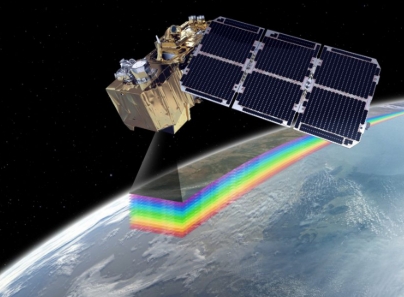
The AI module performs part of the imagery analysis on board rather than transmitting all raw hyperspectral data to the ground. By filtering and processing data in orbit, the system reduces the volume of information that must be downlinked and accelerates the delivery of usable products. Hyperspectral sensors capture reflected light across many narrow wavelength bands, enabling finer discrimination of surface materials, vegetation stress, soil moisture and other parameters than conventional multispectral imagery. Combined with on-board AI, the approach is intended to support applications in agriculture, environmental monitoring, water-resource management and land-use planning.
Uzbekistan’s contribution reflects a deliberate strategy to move beyond pure data reception toward the development of indigenous space technology. Uzcosmos has prioritised capacity-building in remote sensing, AI models tailored to local crops such as cotton and grain, and international partnerships that allow Uzbek engineers to place hardware and software on operational platforms. The Samarkand-2028 flight is the most visible result of that effort to date.
The launch also illustrates the growing role of commercial and cooperative space activity in Central Asia. China’s commercial launch and satellite providers have become important partners for countries seeking affordable access to orbit. For Uzbekistan the arrangement provides both technical experience and a pathway to practical data products that can support national development priorities. Officials have highlighted potential benefits for precision agriculture, disaster monitoring and environmental protection across the region’s varied terrain and climate zones.
For competitive-exam aspirants the event supplies material for several recurring themes. Emerging space powers and the democratisation of access to orbit appear in questions on science and technology. The integration of artificial intelligence with remote sensing raises issues of data volume, latency, edge computing and the value of processed versus raw information. International cooperation in space, particularly between China and Central Asian states, fits within broader discussions of multipolar technology partnerships. Applications in agriculture and resource management link the topic to India’s own experience with remote sensing for crop forecasting, drought monitoring and watershed management.
The on-orbit processing approach itself is noteworthy. Traditional Earth observation architectures send large volumes of data to ground stations for subsequent analysis. On-board AI can prioritise relevant scenes, detect anomalies, and generate preliminary classifications before downlink, improving efficiency when bandwidth or contact time is limited. As AI models become more capable and radiation-hardened hardware more available, similar architectures are expected to proliferate.
Uzbekistan’s achievement does not place it among the traditional spacefaring powers, yet it demonstrates a realistic pathway for mid-sized economies to participate in the space value chain through specialised software and targeted partnerships. The success of the AI module will be measured by the quality and utility of the data products delivered to end users in agriculture, environment and government planning. Early reports indicate that the satellite is functioning as designed and that the Uzbek module is operating in orbit.
Accurate knowledge of the launch date, the partnership structure, the function of the AI module, the hyperspectral capability, and the symbolic naming linked to the 2028 International Astronautical Congress will equip aspirants to answer both factual and analytical questions on this development in science, technology and international cooperation.
Frequently Asked Questions
What was launched with the Samarkand-2028 satellite?
A hyperspectral Earth observation satellite carrying an AI processing module developed by Uzbek engineers from Uzcosmos, launched on 5 August 2026 in partnership with China’s STAR.VISION.
What does the AI module do?
It processes part of the hyperspectral imagery while still in orbit, analysing data before transmission to reduce downlink volume and improve the speed of usable information delivery.
Why is the satellite named Samarkand-2028?
The name commemorates Samarkand’s selection to host the 2028 International Astronautical Congress, the first time the event will be held in Central Asia.
Why is this relevant for exam aspirants?
It covers emerging space powers, AI applications in remote sensing, on-orbit data processing, international space cooperation, and practical uses in agriculture and environmental monitoring—topics that appear in science, technology and international relations questions.
Master Space & Defense Technology Current Affairs
In-depth coverage of satellite missions, space agencies, and emerging technology breakthroughs.
Daily Current Affairs → All Exams →Join our official Telegram channel for instant updates: @rrbcontents