Home › Blog › International Relations › US-India-China Geopolitics
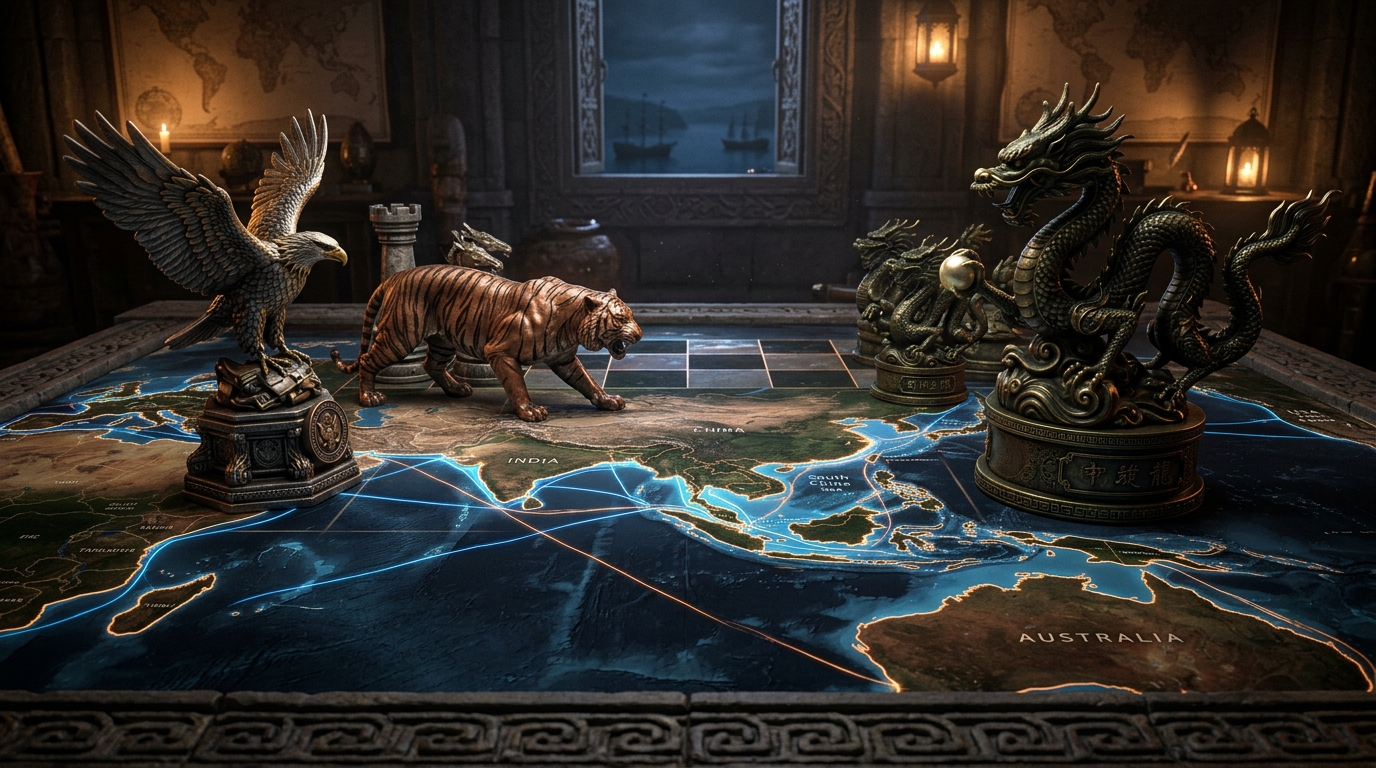
Why US Can’t Bear Another China: India’s Rise in Geopolitics
The United States has spent the better part of two decades treating China as its primary strategic challenge. Official documents call the competition the defining story of the twenty-first century. Beijing’s military modernisation, technological ambition, and economic scale have forced Washington to rethink everything from supply chains to alliance structures.
Yet a quieter, more complicated calculation is unfolding around India. For years American policymakers spoke of New Delhi as a natural democratic counterweight, a partner whose rise would help balance Chinese power in Asia. Recent statements suggest a shift. In March 2026, a senior US official visiting New Delhi said plainly that America would not repeat the mistakes it made with China twenty years earlier—letting a rising power freely develop markets only to find itself outcompeted later.
So why does Washington appear unwilling to tolerate another China-scale power? And why do some American strategists now view India’s trajectory with a mixture of hope and caution? The answer lies in hard lessons from the past, the realities of economic power, and the limits of strategic partnership in an era of great-power rivalry. This analysis examines the full picture—historical context, current facts, political and economic dimensions, social and environmental angles where relevant, official responses, criticisms, and the way forward—while keeping an eye on what serious students of international relations and competitive examinations need to understand.
Table of Contents
- 1. Background and Historical Context of US-China Competition
- 2. What Exactly Has Changed in US Thinking Toward India
- 3. Why the United States Cannot Afford Another China
- 4. Why India Is Seen as a Potential Second China
- 5. Political and Strategic Dimension
- 6. Economic Dimension and the China-Plus-One Reality
- 7. Social, Cultural and Domestic Constraints
- 8. International and Geopolitical Implications
- 9. Government Responses and Official Positions
- 10. Criticism, Counter-Arguments and Systemic Limits
- 11. Way Forward and Relevance for Competitive Examinations
- 12. Strategic Comparison & Must-Remember Points
1. Background and Historical Context of US-China Competition
The roots of today’s tension go back to the late 1970s and the decision to engage China economically. American policymakers believed that integrating Beijing into the global trading system would produce a more open, status-quo power. China’s entry into the World Trade Organization in 2001 accelerated that process. Over the next two decades China became the world’s manufacturing workshop. US companies relocated production, American consumers enjoyed cheaper goods, and Wall Street gained new markets.
The strategic cost became visible only later. Manufacturing employment in the United States declined sharply in certain sectors. Technology transfer, both voluntary and involuntary, helped China close gaps in critical industries. By the mid-2010s Chinese military modernisation, assertive behaviour in the South China Sea, and the Made in China 2025 industrial plan had altered the balance. Successive US National Security Strategies—from the Trump administration in 2017 through subsequent documents—identified China as the pacing threat.
India entered this picture as a contrasting case. A democracy with a large population, a growing economy, and unresolved border disputes with China, New Delhi appeared to many in Washington as a natural partner. The civil nuclear deal of 2008, the revival of the Quad, and expanding defence and technology cooperation reflected that assessment. For nearly twenty years a bipartisan consensus treated India’s rise as beneficial to American interests.
That consensus is now under strain. The experience with China has taught Washington that economic scale, technological ambition, and demographic size can produce a peer competitor faster than expected. The fear is not simply that India will become hostile. It is that another continental-sized economy could eventually challenge American commercial and technological leadership in ways that prove difficult to manage.
2. What Exactly Has Changed in US Thinking Toward India
Recent official language is more careful and more transactional. The 2025 National Security Strategy and related statements continue to value cooperation with India on Indo-Pacific security and the Quad. Yet the emphasis has shifted. India is described as a partner that should contribute to regional security, including through the Quad, while commercial relations are to be improved on terms that advance US economic interests and avoid repeating past mistakes.
A March 2026 remark by a senior State Department official in New Delhi captured the new mood most clearly. The United States, the official said, would not allow India the same open-ended space that China once enjoyed to develop markets and then outperform American firms. The comment was not an official repudiation of partnership. It was a public signal that America’s own industrial base and technological edge remain non-negotiable priorities.
Simultaneously, some adjustments in terminology and prioritisation have been noticed. References to the broader Indo-Pacific have occasionally given way to a sharper focus on the Pacific and the First Island Chain. Defence planning documents emphasise denial strategies closer to China’s periphery. India remains important, particularly for Indian Ocean security and as a large market, but the earlier romanticism of an unlimited strategic embrace has cooled.
3. Why the United States Cannot Afford Another China
The core reason is structural. China today possesses a manufacturing ecosystem built over decades, a massive internal market, advanced supply chains, and the ability to convert economic power into military and technological capacity at speed. A second power of comparable scale would multiply the challenges of maintaining a favourable balance.
American strategists worry about several concrete risks. First, technological competition: semiconductors, artificial intelligence, quantum computing, and advanced materials are now domains of national security. A second large economy racing ahead in these fields would intensify the race and raise costs. Second, industrial capacity: the United States is still rebuilding its own manufacturing base after decades of offshoring. Allowing another low-cost, high-volume producer to dominate global markets would undermine that effort. Third, geopolitical leverage: economic interdependence can become a source of coercion, as seen in rare-earth restrictions and supply-chain pressures.
There is also a domestic political dimension. Both major US parties now treat industrial policy and supply-chain security as mainstream concerns. Voters in manufacturing states remember the costs of the earlier China engagement. Any policy that appears to create a second such competitor faces immediate political resistance. In short, the United States has concluded that one peer competitor is already difficult enough. A second would stretch resources, alliances, and domestic consensus beyond comfort.
4. Why India Is Seen as a Potential Second China
India’s scale is the first reason. With a population exceeding 1.4 billion and a median age far younger than China’s, India offers a long demographic window. Economic growth has remained robust. Official and independent estimates for recent fiscal years place real GDP expansion in the 6.5 to 7.8 per cent range, consistently higher than most major economies including China. Manufacturing has gained momentum under Production-Linked Incentive schemes, infrastructure investment, and the global China-plus-one diversification. Electronics exports, particularly smartphones, have risen sharply. Foreign direct investment into manufacturing has shown healthy growth.
Geography adds strategic weight. India sits astride key Indian Ocean sea lanes and shares a long, contested border with China. Its navy and growing maritime domain awareness capabilities matter for any free-and-open Indo-Pacific concept. Democratic institutions, however imperfect, provide a normative contrast that many American policymakers still value.
Taken together, these factors create the possibility—not the certainty—of India becoming a large, competitive manufacturing and technology power over the next two decades. That possibility is precisely what triggers caution in Washington. The United States wants India strong enough to complicate Chinese calculations, wealthy enough to buy American goods and services, and capable enough to share security burdens. It does not want an India that eventually rivals American commercial dominance in the way China has.
5. Political and Strategic Dimension
The relationship remains partnership-oriented but asymmetrical. Defence cooperation has expanded through foundational agreements, joint exercises, and technology initiatives such as the Initiative on Critical and Emerging Technology. The Quad continues to function as a platform for maritime security, critical minerals, and infrastructure coordination, even if leaders’ summits have faced scheduling challenges.
Yet India’s insistence on strategic autonomy creates friction. New Delhi continues to buy energy from Russia, maintains relations with Iran, and refuses to be drawn into formal alliances. American officials sometimes interpret this independence as insufficient alignment. Indian policymakers see it as the only realistic posture for a country that must manage a difficult neighbourhood, a large developmental agenda, and multiple great-power relationships simultaneously.
Under the current American administration the tone has become more transactional. Trade talks proceed alongside tariff pressures. Regional policy in South Asia occasionally takes steps that New Delhi views as unhelpful. The net effect is a relationship that is still valuable to both sides but no longer carries the earlier assumption of automatic strategic congruence.
6. Economic Dimension and the China-Plus-One Reality
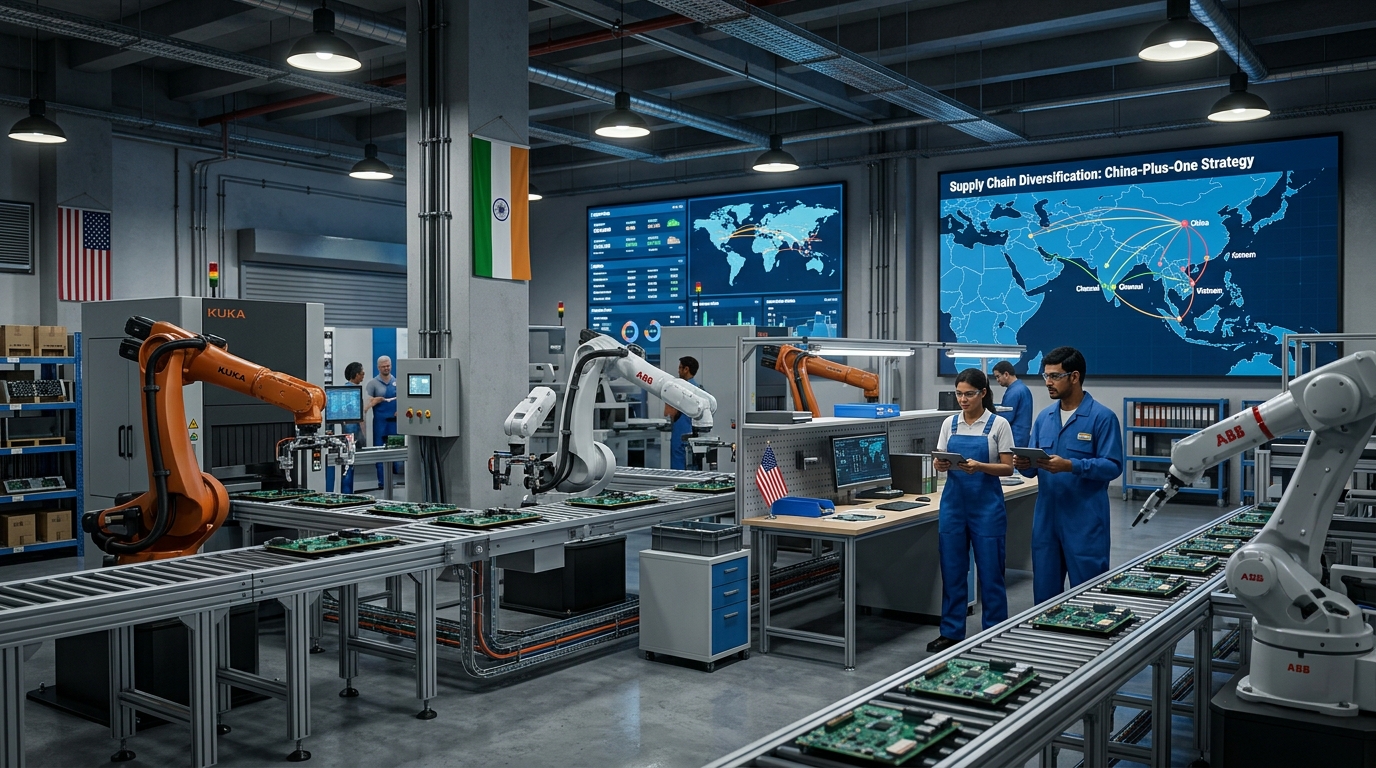
Here the tension is sharpest. American companies continue to diversify production away from China. India has emerged as one beneficiary. Apple’s expanding manufacturing footprint, rising electronics exports, and increased FDI inflows demonstrate real progress. Yet the United States simultaneously seeks greater market access for its own goods and services and remains sensitive to any rapid Indian advance in sectors where American firms still hold advantages.
Bilateral trade has grown, but the deficit has also widened in some recent years. Negotiations for broader trade frameworks aim at higher volumes while protecting American industrial interests. The message from Washington is consistent: partnership yes, but not at the cost of repeating the China experience of lost industrial capacity and technological catch-up by a rising power.
For India the opportunity is clear. Global firms need alternatives. Domestic demand is rising. Policy continuity on infrastructure, logistics, and ease of doing business will determine how much of the China-plus-one shift actually materialises on Indian soil. The risk is that American caution could limit technology transfer or market access precisely in the areas where India needs scale to compete.
7. Social, Cultural and Domestic Constraints
Public opinion in both countries shapes the relationship. In the United States, concerns about jobs, immigration, and technological competition colour attitudes toward any large emerging economy. In India, memories of colonial economic subordination and pride in strategic autonomy make deep alignment with any single power politically sensitive.
Domestic priorities also differ. India must generate millions of jobs every year, expand manufacturing employment, and manage internal diversity. The United States must rebuild industrial communities and maintain technological leadership. These internal imperatives sometimes pull the two countries in different directions even when their external interests overlap.
8. International and Geopolitical Implications
A restrained American approach to India’s rise has wider consequences. Other Indo-Pacific partners—Japan, Australia, Southeast Asian states—watch carefully. If Washington appears to manage India’s growth too tightly, regional confidence in American staying power could weaken. China, for its part, may calculate that a more transactional US-India relationship reduces the effectiveness of balancing coalitions.
India itself is already adapting. New Delhi continues to deepen ties with Japan, Australia, Europe, and ASEAN partners while carefully managing the difficult relationship with Beijing. The emerging preference for multi-alignment—sometimes described as a “G-minus-two” approach that reduces over-dependence on either Washington or Beijing—reflects this reality. The geopolitical map is becoming more fluid, not more binary.
9. Government Responses and Official Positions
American officials continue to affirm the importance of the partnership. Statements emphasise commercial opportunities, defence cooperation, and India’s contribution to regional security. At the same time they stress that engagement must serve American economic and security interests and avoid the errors of the past.
Indian leaders respond by reiterating strategic autonomy, highlighting domestic growth priorities, and expanding partnerships beyond any single power. Both sides keep channels open. Neither wants a rupture. Both recognise that the relationship remains one of the more consequential bilateral ties of the coming decades. The difference lies in the degree of openness each is prepared to offer the other.
10. Criticism, Counter-Arguments and Systemic Limits
Critics of the harder American line argue that treating India primarily as a potential economic rival risks alienating the very partner needed to balance China. They note that India’s democratic character, demographic trajectory, and geographic position still make it a unique asset. Constraining its rise could leave Washington with fewer options if competition with Beijing intensifies.
Others contend that the caution is overdue. The China experience showed that economic engagement without sufficient safeguards can produce a competitor. Applying lessons learned is simply prudent statecraft.
A third view holds that the entire framing is overstated. India faces its own structural constraints—infrastructure gaps, skill mismatches, regulatory complexity, and the need to absorb a large workforce into productive employment. Becoming a second China in the full sense is neither automatic nor imminent. The real task is steady, realistic partnership rather than either unrestricted promotion or quiet containment.
11. Way Forward and Relevance for Competitive Examinations
The most constructive path lies in clear-eyed realism. The United States can support Indian capacity in areas that strengthen mutual security—maritime domain awareness, critical technologies under controlled frameworks, and resilient supply chains—while protecting its own industrial core. India can accelerate domestic reforms that make it a more reliable manufacturing and innovation partner without compromising strategic autonomy. Both sides benefit from transparent dialogue on technology, trade, and regional security.
Relevance for Competitive Examinations (UPSC GS-2, SSC, Banking):
For competitive examination aspirants the topic sits at the intersection of international relations, economy, and current affairs. Key points include:
- US National Security Strategy Shift: Evolution from open engagement to supply-chain protection and industrial policy.
- Strategic Autonomy: India's refusal to join formal military alliances while maintaining multi-alignment.
- China-Plus-One & PLI Schemes: Electronics manufacturing, Apple supply chain, and FDI in Indian manufacturing.
- Quad & iCET Initiatives: Technology sharing frameworks (iCET) and maritime domain awareness under the Quad.
- Partnership vs. Alliance: Understanding why US treats India as a strategic partner rather than a treaty ally.
12. Strategic Comparison & Must-Remember Points
| Dimension | US Preference | Indian Preference | Point of Friction |
|---|---|---|---|
| Economic scale | Strong market, limited competitive threat | Rapid manufacturing and tech growth | Technology transfer and market access |
| Security role | Contributor to Indo-Pacific balance | Strategic autonomy, multi-alignment | Degree of alignment against China |
| Technology | Controlled cooperation | Access to advanced capabilities | Export controls and IP concerns |
| Regional order | No single dominant Asian power | Multipolar Asia with Indian voice | South Asian influence |
Quick Revision / Must Remember Points
- US views China’s rise as a strategic mistake enabled by earlier open engagement.
- Official 2026 statements signal no repeat of that open-ended approach with India.
- India remains a valued partner for Indo-Pacific security and as a large market.
- India’s growth (6.5–7.8 per cent range) and manufacturing gains make it a potential long-term competitor.
- Strategic autonomy remains India’s core posture; multi-alignment is the practical response.
- Exam focus: Quad, China-plus-one, Indo-Pacific concept, US NSS language, partner vs. ally.
Conclusion
The United States cannot easily tolerate another China because the first one has already transformed the global balance of power and imposed lasting costs on American industry and strategy. India’s size, growth, and location make it the most plausible candidate for a second such power. Washington therefore seeks a calibrated relationship: useful enough to complicate Chinese plans, open enough for commerce, yet carefully managed so that commercial and technological rivalry does not eventually mirror the China challenge.
India, for its part, will continue to pursue its own rise on its own terms. The coming decade will test whether the two democracies can convert overlapping interests into durable, realistic cooperation without the illusions of the past or the over-corrections of the present. For students of politics and for citizens watching the world order evolve, this is one of the central geopolitical questions of our time.
Master International Relations & Geopolitics on RRBCONTENTS
Get complete IR notes, Indo-Pacific strategic maps, and daily exam current affairs.
Daily Current Affairs → International Relations Notes →Join our official Telegram channel: @rrbcontents